
AI-Assisted DCIM in 2026: From Dashboards to Decisions
For a decade, DCIM meant dashboards, more screens, more graphs, more alarms to ignore. In 2026 the shift is from showing data to *acting* on it: anomaly detection that cuts alarm noise, capacity forecasting, and an AI companion that builds your asset database for you. Here's what "AI-assisted" actually means, and what to ignore.
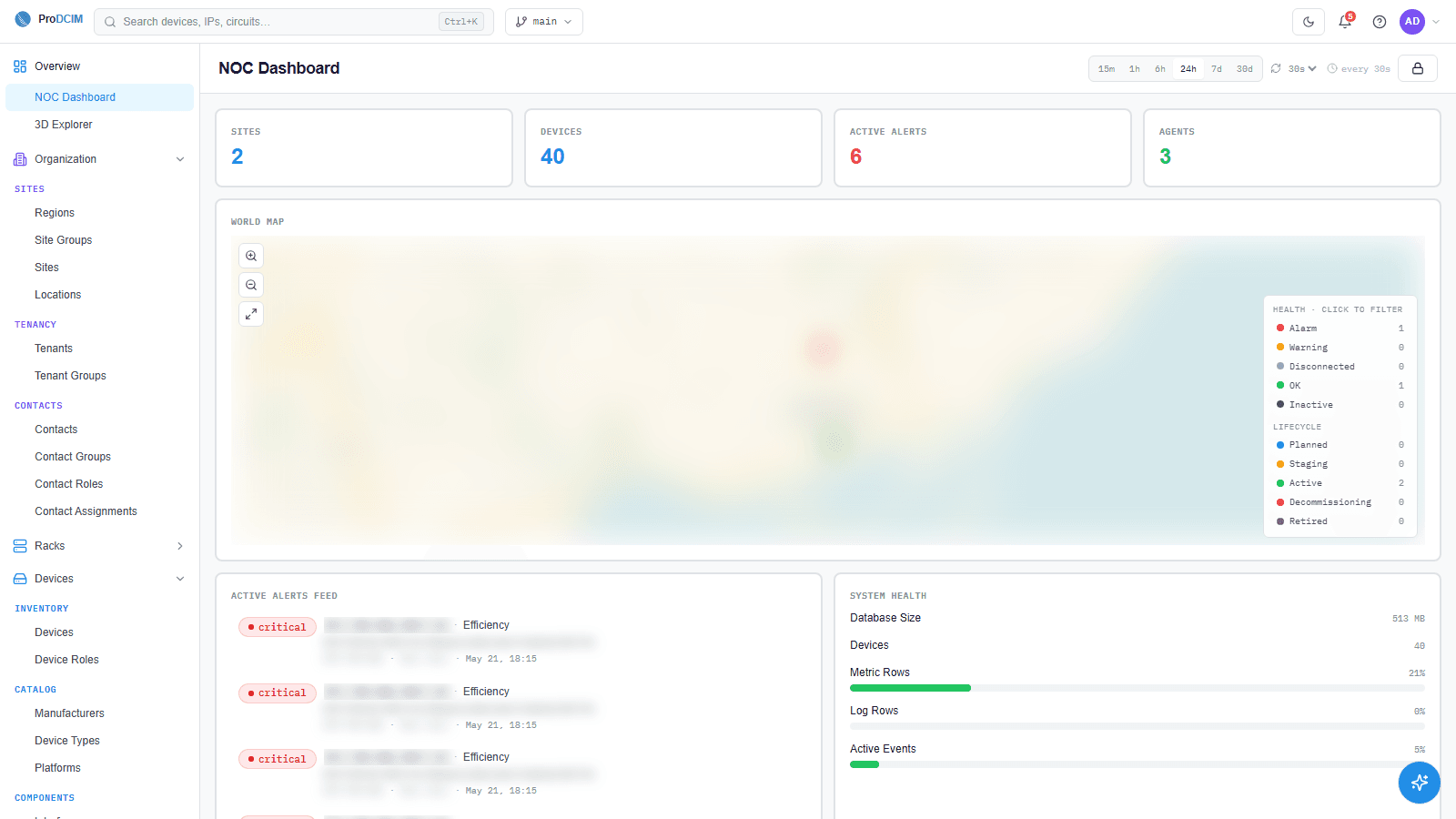
For a decade, "DCIM" mostly meant dashboards. Buy the platform, wire up the sensors, and you get screens, lots of screens. The problem was never a shortage of data. It was that turning that data into a decision still landed on a human at 2 a.m.
In 2026 the interesting work in data center infrastructure management isn't another chart. It's software that closes the gap between seeing a problem and doing something about it. Below is what "AI-assisted" actually means in practice, and what's just a logo on a slide.
The dashboard plateau
A wall of green tiles feels like control. It isn't. Three things break the illusion:
- Alarm fatigue. When everything pages, nothing does. Teams mute channels, raise thresholds, and miss the one alert that mattered.
- Stale truth. The asset database that was accurate at install is wrong six months later, and nobody trusts it enough to act on it.
- Hindsight reporting. Most dashboards are great at telling you what already broke.
AI is useful precisely where these fail: deciding what deserves attention, keeping the record current, and seeing trouble before it trips a threshold.
What "AI-assisted" actually means
Strip away the marketing and there are four capabilities worth paying for:
- 1Anomaly detection on real signals. Instead of a fixed "alert at 32 °C," the system learns a device's normal rhythm and flags the deviation, a fan drawing more current than its peers, an inlet temperature drifting up week over week.
- 2Alarm-noise reduction. Correlate related events into one incident with the likely root cause attached, so the on-call gets a story, not a storm.
- 3Capacity and failure forecasting. Project power, cooling, and space headroom; surface the rack that's trending toward a limit before it's a problem.
- 4Assisted asset discovery. Build and maintain the CMDB from what's actually on the network, in plain language, instead of by hand.
The test for any "AI" feature is simple: does it remove work a human was doing, or add a panel a human now has to watch? Only the first kind earns its place.
From alarm storm to signal
The most immediate win is alarm quality. A good system groups the forty alerts from a single failover into one incident, ranks it by real impact, and routes it to the right person with the site, the reading, and the runbook attached. The metric to watch isn't "alerts generated", it's alerts a human had to triage that turned out to be nothing. Drive that toward zero and you've bought back your team's attention.
The CMDB problem AI finally cracks
Ask any operations lead for their biggest data-quality headache and you'll hear the same answer: the asset database. Built by hand, it's weeks of discovery and spreadsheets, and it's out of date the moment you finish.
This is where assisted discovery changes the economics. An AI companion can interrogate the network over the protocols your gear already speaks, populate rack, device, and connection records, and keep them current as things change, turning a quarterly fire drill into a living source of truth. The point isn't to remove the human; it's to make the human an editor instead of a data-entry clerk.
On-prem vs cloud AI: where your data lives
Here's the question that decides everything for regulated and critical infrastructure: does the model run on your data, or does your data run to the model?
| Cloud AI | On-prem / edge AI | |
|---|---|---|
| Data residency | Leaves your boundary | Stays in your facility |
| Latency | Round-trip to a provider | Local, real-time |
| Works during a WAN outage | No | Yes |
| Best for | Bursty, non-sensitive analysis | Sovereign, always-on operations |
For operators who answer to data-sovereignty rules, or who simply can't have monitoring intelligence go dark when the link does, on-prem or edge inference isn't a preference, it's a requirement. The right platform lets you choose per workload rather than forcing one model.
What to ask a vendor
Cut through the demos with five questions:
- Show me an anomaly you caught that a static threshold would have missed.
- How many alerts does a typical failover generate, before and after correlation?
- Where does the model run, and what happens to it during a WAN outage?
- How is the asset database kept current after go-live?
- What does the system do automatically, and what still needs a human to approve?
Getting started
You don't need to rip anything out. Start by pointing AI-assisted analysis at the noisiest part of your estate, usually power and environmental alarms, and measure the drop in nuisance pages. Add forecasting once you trust the signal. Let assisted discovery take over the CMDB last, when you've seen it read your gear accurately.
DCIM's first decade was about visibility. The next is about judgment, software that helps a small team run more sites, more calmly, with the data staying exactly where it belongs.
Want to see AI-assisted monitoring on your own racks? [Book a walkthrough](/request-demo/) and we'll map it to your environment.
See it on your own racks
Book a walkthrough mapped to your environment: monitoring, asset management and out-of-band resilience across every site.
More insights
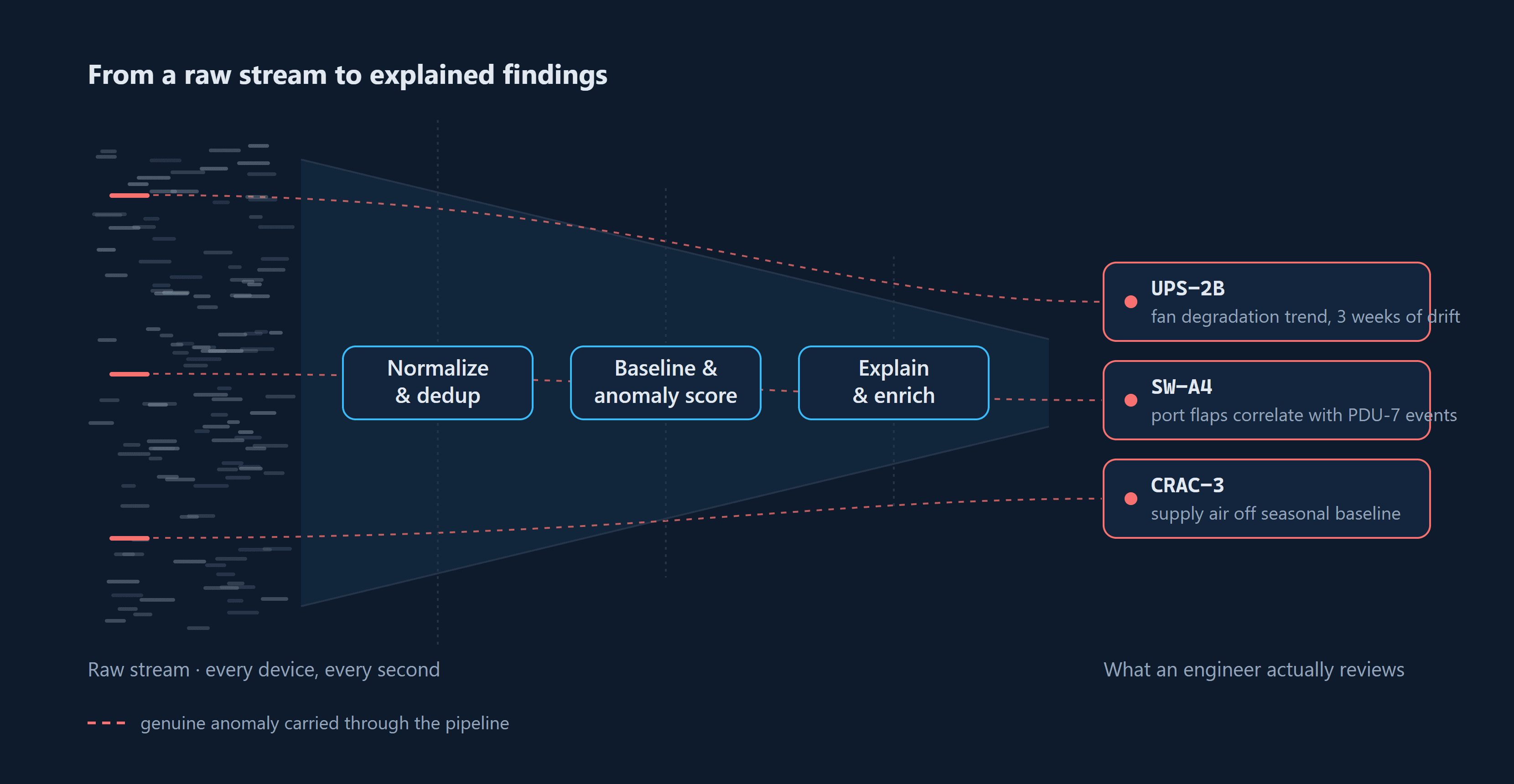
From Noise to Truth: How AI Turns Device Logs into Trusted Operational Intelligence
Device logs are the most underused asset in infrastructure operations: written once, read never, and yet the first place every failure announces itself. AI changes that equation. Anomalies surface themselves, cryptic vendor errors arrive translated, and the record becomes strong enough to stand in an audit. Here is how noise becomes truth.
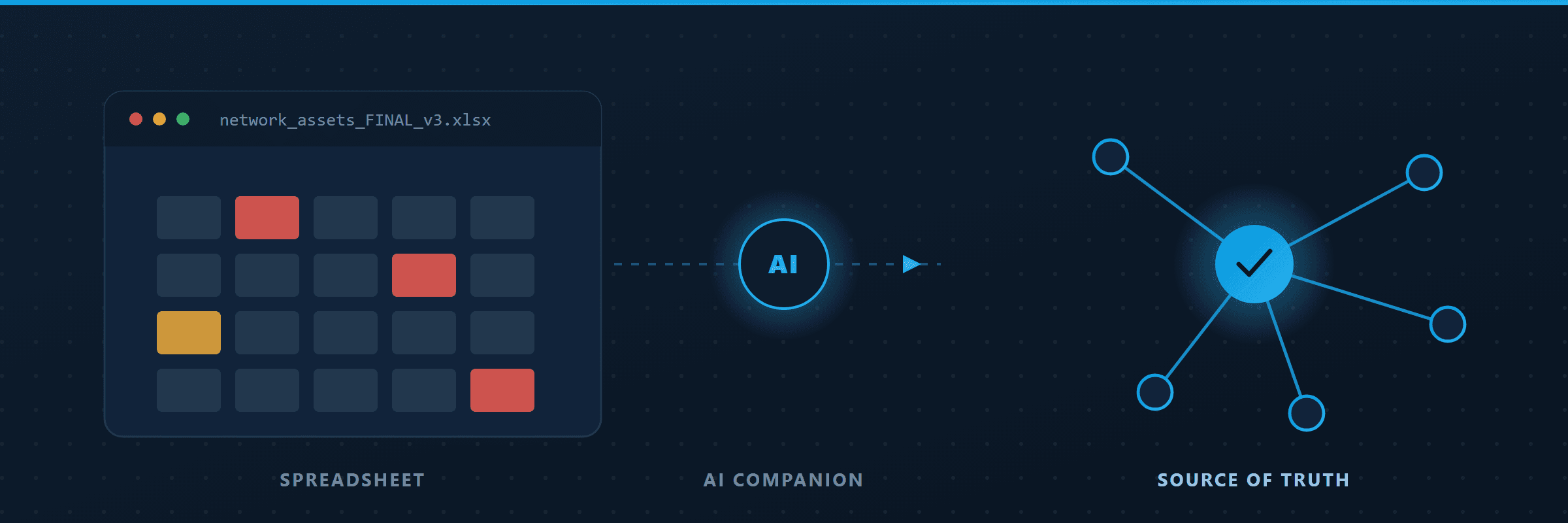
Excel for Your Server Room Is Painful, But a Traditional CMDB Can Hurt More
Your server room probably runs on network_assets_FINAL_v3.xlsx. It works until it does not, and a traditional CMDB can hurt more. Here is why that trade-off finally breaks in the AI era, and what to do instead.
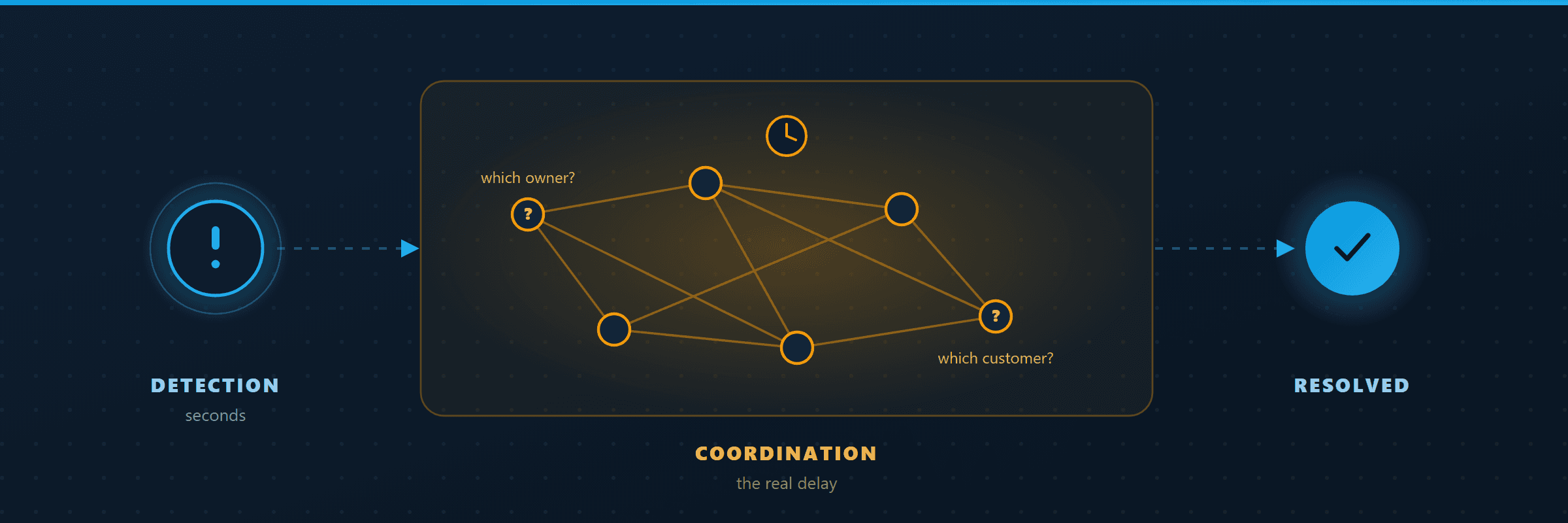
Your Data Center's Hardest Problem Isn't Detection. It's Coordination.
When an incident hits, your monitoring already knows. The real delay is everything that happens next: finding the affected customer, the right owner, the correct procedure, the required approval. ProDCIM AI Employee is built to close that gap.