
Excel for Your Server Room Is Painful, But a Traditional CMDB Can Hurt More
Your server room probably runs on network_assets_FINAL_v3.xlsx. It works until it does not, and a traditional CMDB can hurt more. Here is why that trade-off finally breaks in the AI era, and what to do instead.
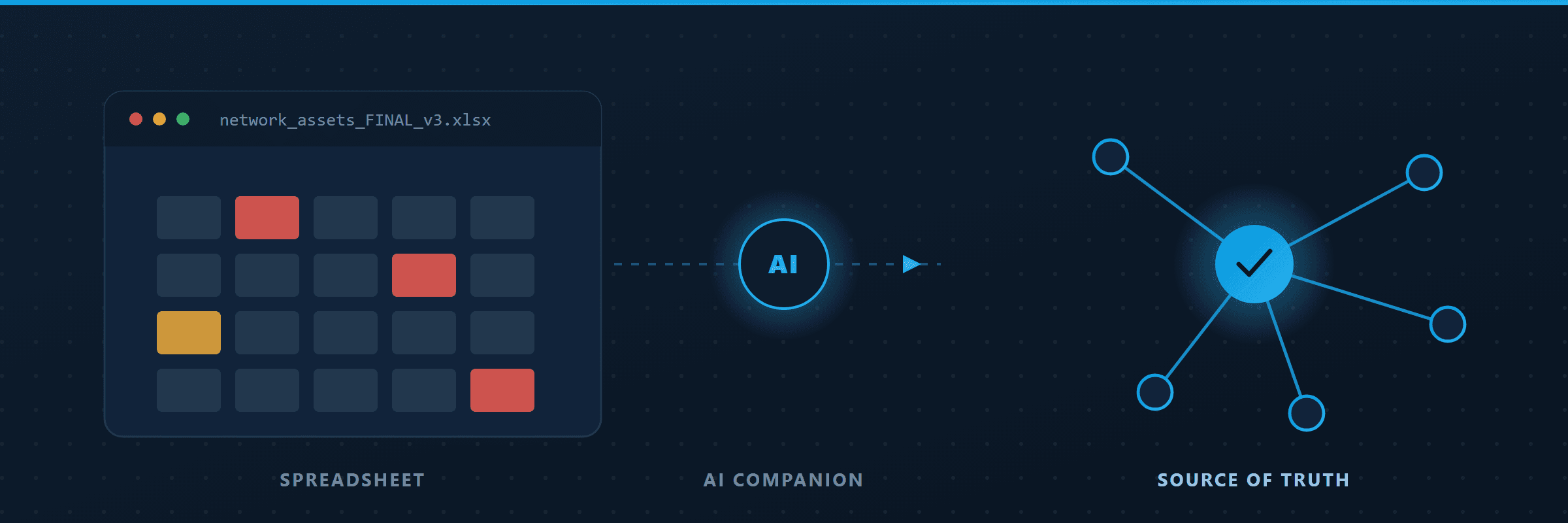
Walk into most server rooms, from a two-rack closet to a mid-size data hall, and ask how the team tracks its servers, switches, cabling, and changes. More often than you would expect, the honest answer is a spreadsheet: a colored, filtered Excel file called something like network_assets_FINAL_v3.xlsx. It works, right up until it does not. And the obvious fix, a Configuration Management Database (CMDB), has a reputation for creating as much work as it removes. That trade-off made sense a decade ago. In the AI era, it no longer does.
Why the spreadsheet quietly becomes a liability
To be fair, Excel earns its place at the start: already installed, free, no rollout, anyone can open it. For a single admin with a few dozen assets, that is genuinely good enough. The trouble is that server rooms do not stay small, and spreadsheets do not fail loudly, they rot quietly.
- Statistically error-prone. A widely cited figure puts the share of spreadsheets containing at least one error near 88%. When your record of which switch feeds which rack is that unreliable, every decision inherits the risk.
- Never current. Excel is a static snapshot that updates only when a human remembers to. That breeds "ghost assets" (recorded but gone) and "zombie assets" (in use but unlogged), with waste estimated up to $50,000 a year for a company holding $2M in assets.
- Fragile under teamwork. Two or three editors bring version conflicts, overwritten formulas, and a swarm of "_v3_edits" copies where nobody knows which is current.
- No memory. No reliable audit trail of who changed what, and when. That is exactly what you need at 2 a.m. or during an audit.
None of this makes spreadsheets bad. They were simply never built to be the system of record for a living network. About a third of organizations still manage IT assets manually, so if this is you, you are in large company, but carrying risk that scales silently as you grow.
The CMDB was supposed to fix this, so why the dread?
A CMDB is the textbook answer: a single, structured source of truth for assets, configurations, and the relationships between them. That relationship data, this app runs on that VM, on that host, through that switch, is what a spreadsheet cannot capture, and what turns an inventory into something genuinely useful. And yet "CMDB" often earns a sigh, and the data explains why:
- Most projects do not succeed. Depending on the source, two-thirds to 80% of CMDB initiatives fail; older analyses put it as high as 85%.
- Manual maintenance is the killer. Gartner has estimated the average firm makes about 10,000 IT changes a year. Keeping a CMDB accurate by hand, one change at a time, is unsustainable.
- So data decays. The average CMDB is estimated to be only about 60% accurate, and an inventory nobody trusts is one people stop using.
- Teams quietly retreat. Faced with dozens of mandatory fields and approval workflows, teams often decide it is too complex and go back to their spreadsheets.
This is the frustration IT managers describe: we wanted less work, but now we manage two things, the facility, and the software that tracks it. The load did not drop; it doubled. Excel is too fragile to scale; the traditional CMDB is too heavy to sustain. For years those were the only two options.
The AI era breaks the trade-off
We have been told AI will absorb the repetitive, manual parts of our jobs. Configuration and asset management is where that promise should pay off, because manual effort is what kills CMDBs, and manual effort is what AI is good at absorbing. The shift shows up at two moments.
At setup: from months of data entry to reading your spreadsheet
The scariest part of adopting a CMDB was always the blank-database problem: months of populating data before any value appears. AI collapses that. A capable model can ingest your messy Excel, interpret inconsistent columns and naming, and map it into a structured configuration database, turning the spreadsheet into a starting point instead of something you abandon. Paired with automated discovery, initial population stops being a manual marathon. It also lowers the human barrier: if you can ask a question in plain language, you do not need a training course to add a server or pull a report.
During management: from firefighting to a system that keeps itself honest
- Keeps data alive: AI-assisted discovery continuously reconciles what is recorded against what is actually there, attacking the accuracy problem head-on.
- Answers in plain language: ask "which switches in Rack B are past warranty?" or "what depends on this server if I take it down tonight?" instead of building queries.
- Makes change safer: understanding relationships and history, AI flags the likely blast radius of a change before you make it.
- Shifts you from reactive to proactive: by spotting anomalies early, AI-driven operations aim to catch issues before they become incidents.
This is not speculative. Analysts project AIOps growing into the tens of billions of dollars, and most organizations have already piloted AI in operations and monitoring. A well-maintained configuration database is now the context backbone that makes that AI layer work: without accurate relationship data, even smart tools miss the real problem.
The takeaway
The old choice was bad: accept the quiet risk of a spreadsheet, or take on the loud burden of a CMDB, trading one pain for another. What changed is not that CMDBs became easy; it is that the thing that made them painful, relentless manual upkeep, is exactly what AI removes. The most promising approach today is a proper source-of-truth database with an AI companion that populates it from your existing data, keeps it accurate automatically, and lets you operate it in plain language, ideally running inside your own environment, so intelligence never costs you data security.
If you have run your server room from a spreadsheet because a CMDB felt like too much work, that instinct was fair. It is also worth reconsidering, because now you can get the rigor without the manual workload.
This is exactly how ProDCIM approaches asset and configuration management: an AI Companion that ingests your existing records, keeps them reconciled automatically through discovery, and answers in plain language, all running on infrastructure you control. You get the rigor of a source of truth without the manual upkeep that sinks most CMDB projects. See how ProDCIM does it.
References
- 1Assetze, The Challenges of IT Asset Management (about 88% of spreadsheets contain at least one error). blogs.assetze.com
- 2AssetLoom, ITAM Spreadsheet (ghost and zombie assets; about $50k per year waste). assetloom.com
- 3InvGate, Excel for Asset Management (about 34% still use manual methods). blog.invgate.com
- 4Reftab, Spreadsheet vs Dedicated Software (version-conflict and scaling tipping points). reftab.com
- 5AdminRemix, 8 Common ITAM Problems (data fragmentation; audit-failure risk). adminremix.com
- 6Devoteam, Why Do CMDBs Fail? (Gartner: 70 to 80% of organizations fail to build a proper CMDB). devoteam.com
- 7Forbes / SungardAS, Why 85% of Companies Fail at Creating a CMDB (10,000 changes per year; overly manual). forbes.com
- 8Jitendra Zaa, CMDB Complete Guide (failure rates; average CMDB about 60% accurate). jitendrazaa.com
- 9ITSM Consultancy, Why Most CMDBs Fail (teams retreat to spreadsheets when it is too complex). itsmconsultancy.co.uk
- 10Forbes Business Development Council, The AI-Powered CMDB (reactive firefighting; automated discovery). forbes.com
- 11Rezolve.ai, How CMDB Powers AIOps (CMDB as context backbone; dependency-aware analysis). rezolve.ai
- 12Zylos Research, AIOps (market growth; 84% piloting AI in observability by 2026). zylos.ai
See it on your own racks
Book a walkthrough mapped to your environment: monitoring, asset management and out-of-band resilience across every site.
More insights
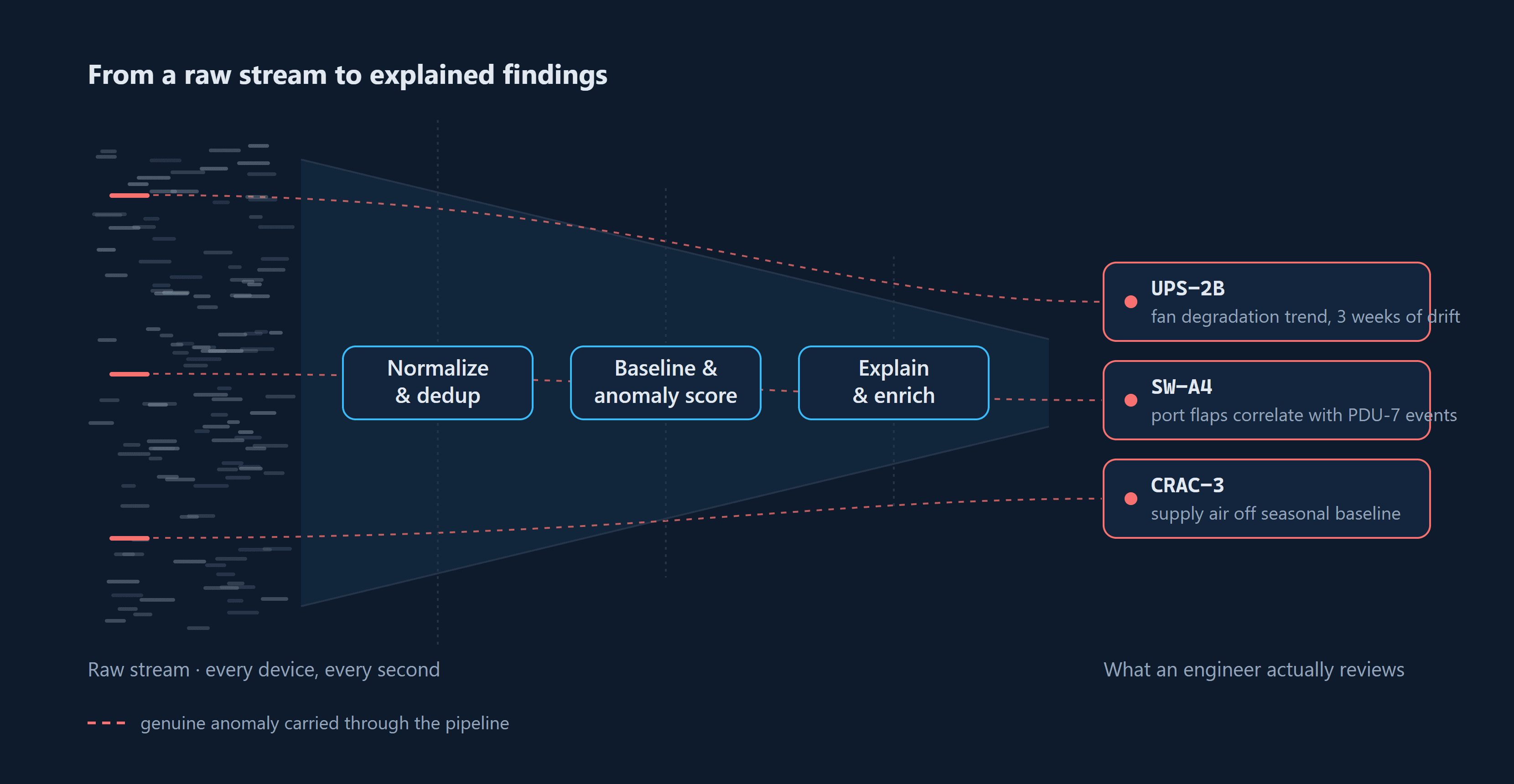
From Noise to Truth: How AI Turns Device Logs into Trusted Operational Intelligence
Device logs are the most underused asset in infrastructure operations: written once, read never, and yet the first place every failure announces itself. AI changes that equation. Anomalies surface themselves, cryptic vendor errors arrive translated, and the record becomes strong enough to stand in an audit. Here is how noise becomes truth.
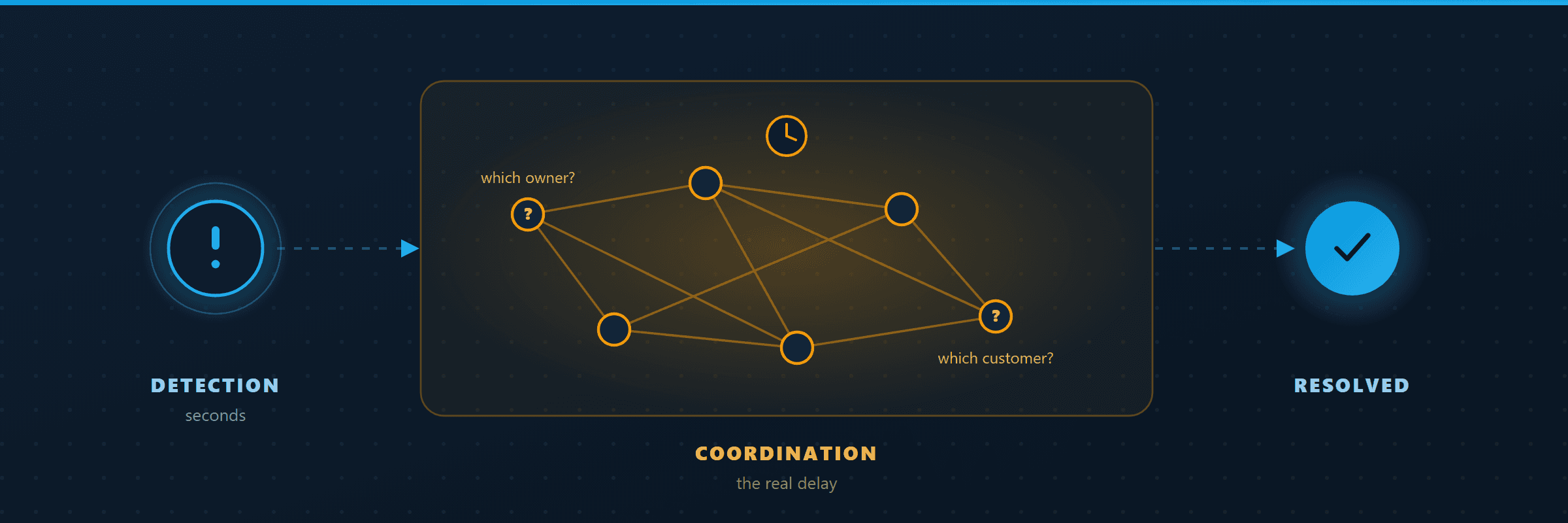
Your Data Center's Hardest Problem Isn't Detection. It's Coordination.
When an incident hits, your monitoring already knows. The real delay is everything that happens next: finding the affected customer, the right owner, the correct procedure, the required approval. ProDCIM AI Employee is built to close that gap.
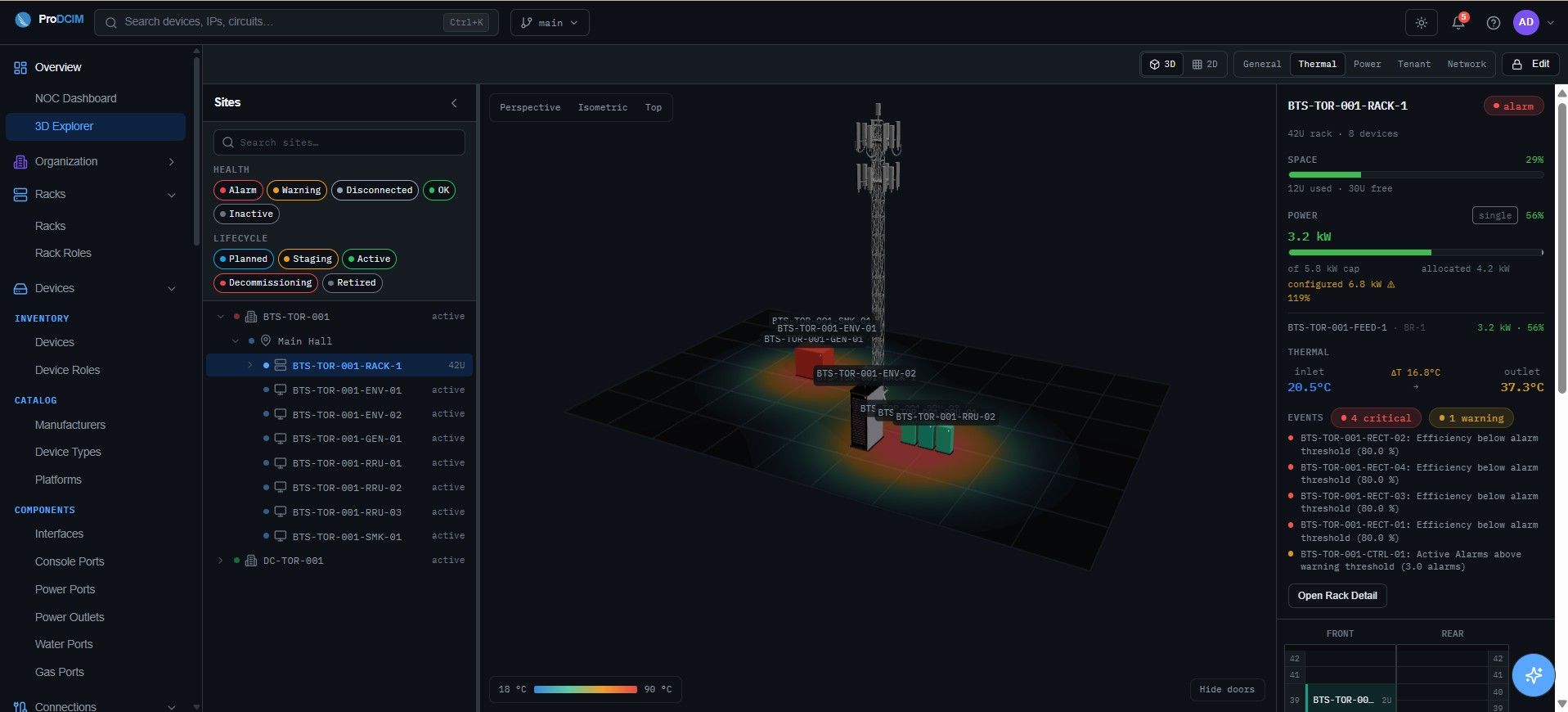
Introducing the New Prochista: A New Website and Next-Generation Platform
We've unveiled a brand-new website and the next generation of our software interface, and we're kicking off a weekly deep dive into the Prochista platform, from hardware monitoring to remote-site resiliency.