
From Noise to Truth: How AI Turns Device Logs into Trusted Operational Intelligence
Device logs are the most underused asset in infrastructure operations: written once, read never, and yet the first place every failure announces itself. AI changes that equation. Anomalies surface themselves, cryptic vendor errors arrive translated, and the record becomes strong enough to stand in an audit. Here is how noise becomes truth.
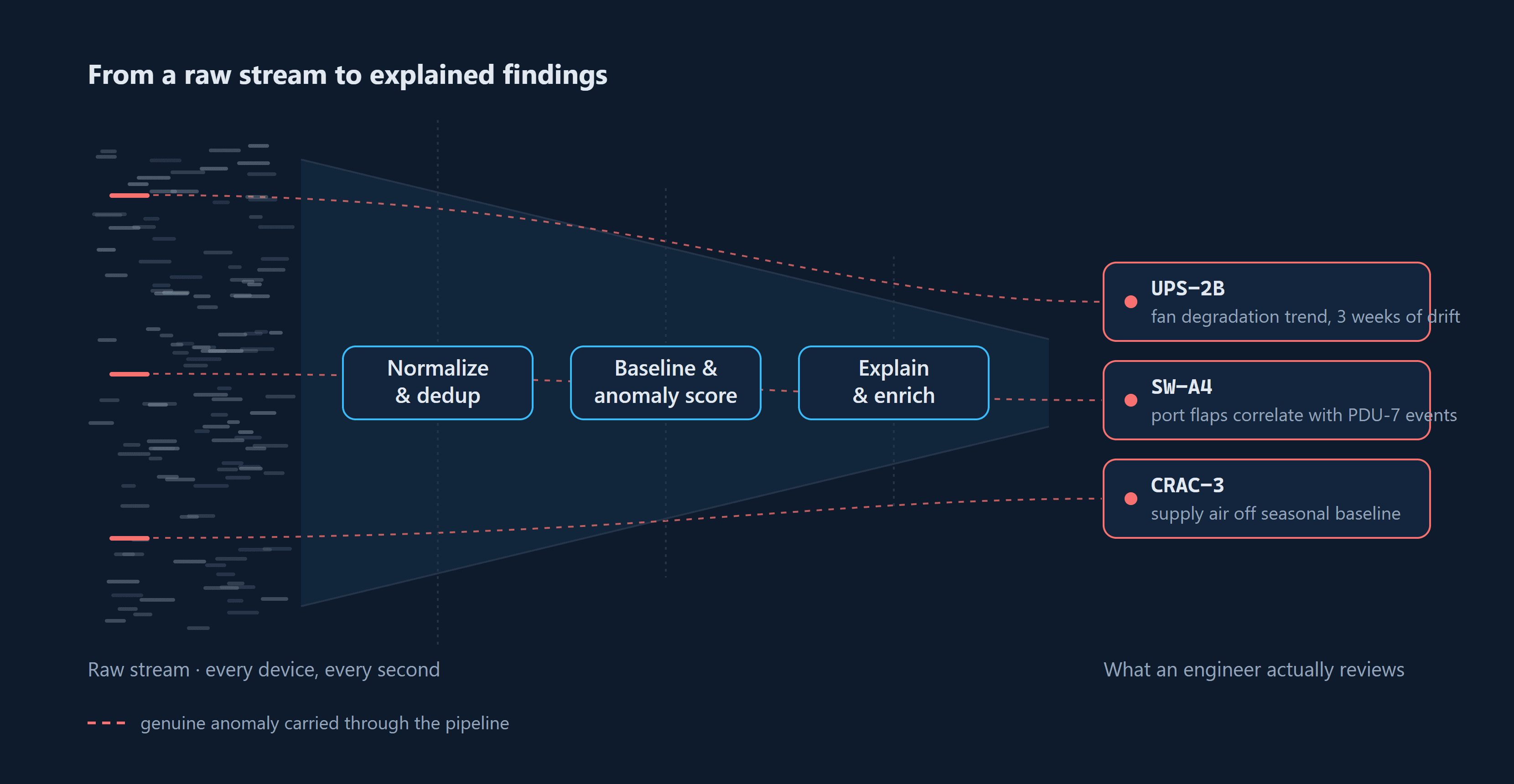
Device logs become trusted operational intelligence when three things happen to them automatically: the stream is cut down to genuine anomalies, every event is translated into plain language with context attached, and the record itself is normalized until it can stand as evidence. Modern AI does all three well. That is the whole shift, and it is why the least-read data in your facility is quietly becoming the most valuable asset you own.
Every device in a modern facility is talking. Switches, servers, sensors, UPS systems, cooling units, PDUs, controllers: all of them write a continuous stream of log data, every second of every day. In 2026, with AI workloads driving unprecedented infrastructure growth, that stream has become a flood. More devices, denser racks, hybrid estates, and edge sites mean the volume of telemetry an operations team is expected to absorb has never been higher. And at Prochista Smart Technologies we see the same uncomfortable truth everywhere we work: most of that data is written once and read never. Logs are treated as exhaust, not evidence. They pile up in storage until an incident forces someone to dig through them, usually under pressure, usually too late.
Why does traditional log management break down?
The problem is not that teams lack data. The problem is that raw logs, in their native form, actively resist being useful. In our work with operations teams, the same barriers come up again and again.
The first barrier is sheer volume. An engineer facing thousands of new lines a day cannot review them all, so triage becomes guesswork. Critical warnings hide inside walls of routine chatter, and over time a dangerous habit forms: alert fatigue. Google's Site Reliability Engineering handbook is blunt about where that road leads: alerts that are not consistently actionable teach responders to ignore the channel that carries them. When everything looks urgent, nothing does.
The second barrier is human interpretation. Manual review depends on who is reading, how experienced they are, and how tired they happen to be. One engineer tags an event as a fault; another dismisses the same pattern as normal. Inconsistent tagging, missed warnings, and unintentionally biased reporting creep in, and the record of what happened becomes as unreliable as the process that produced it.
The third barrier is context. A log entry tells you what happened at the micro level: a port flapped, a threshold was crossed, a service restarted. It almost never tells you why, or what it means for the wider operation. Connecting a cryptic vendor error code to a business impact still requires a human expert, and experts are the scarcest resource on the floor.
All of this erodes trust, and the erosion is not new. NIST's guide to log management (SP 800-92) has warned since 2006 that organizations routinely generate more log data than their teams can analyze, and the balance has only worsened as infrastructure has grown. When logs are noisy, inconsistent, and slow to verify, stakeholders stop treating them as a definitive record. Auditors ask for evidence and get a week of forensics instead. Post-incident reviews stall on incomplete data. The one dataset that should function as a single source of truth becomes the dataset nobody quite believes.
What does AI actually change?
Layering machine learning over the log stream attacks each of these barriers directly, and the progress across the industry in the past two years has been remarkable.
It starts with automated anomaly detection. Instead of fixed thresholds that fire on every minor fluctuation, models establish a baseline of what normal looks like for your specific environment, across seasons, load profiles, and equipment types. They watch the stream continuously, collapse duplicate and low-value events, and surface only genuine deviations, often by correlating several parameters that each look harmless on their own. The practical effect is a change in what engineers do: they stop inspecting entries and start responding to findings.
Next comes contextual analysis and translation, arguably the most visible shift of the generative AI era. Modern models read an obscure, vendor-specific error message and restate it in plain language: what it means, what likely caused it, and what to check first. Just as importantly, teams can now interrogate their logs conversationally. Rather than writing queries in a specialized language, an on-call engineer simply asks which errors appeared on a given system in the last thirty minutes and gets an immediate, readable answer. The learning curve flattens dramatically, and junior staff resolve issues that once waited for a senior specialist.
Then there is the leap from hindsight to foresight. Because models learn the patterns that precede failures, log analysis becomes predictive rather than archaeological. Gradual drifts, early degradation signatures, and recurring pre-failure sequences get flagged with enough lead time to schedule maintenance instead of scrambling through an outage. Across the industry this is converging with the broader 2026 trend toward agentic, self-healing operations, where a system that detects a developing problem can initiate the corrective runbook under human oversight. The log stops being an autopsy report and becomes an early warning system.
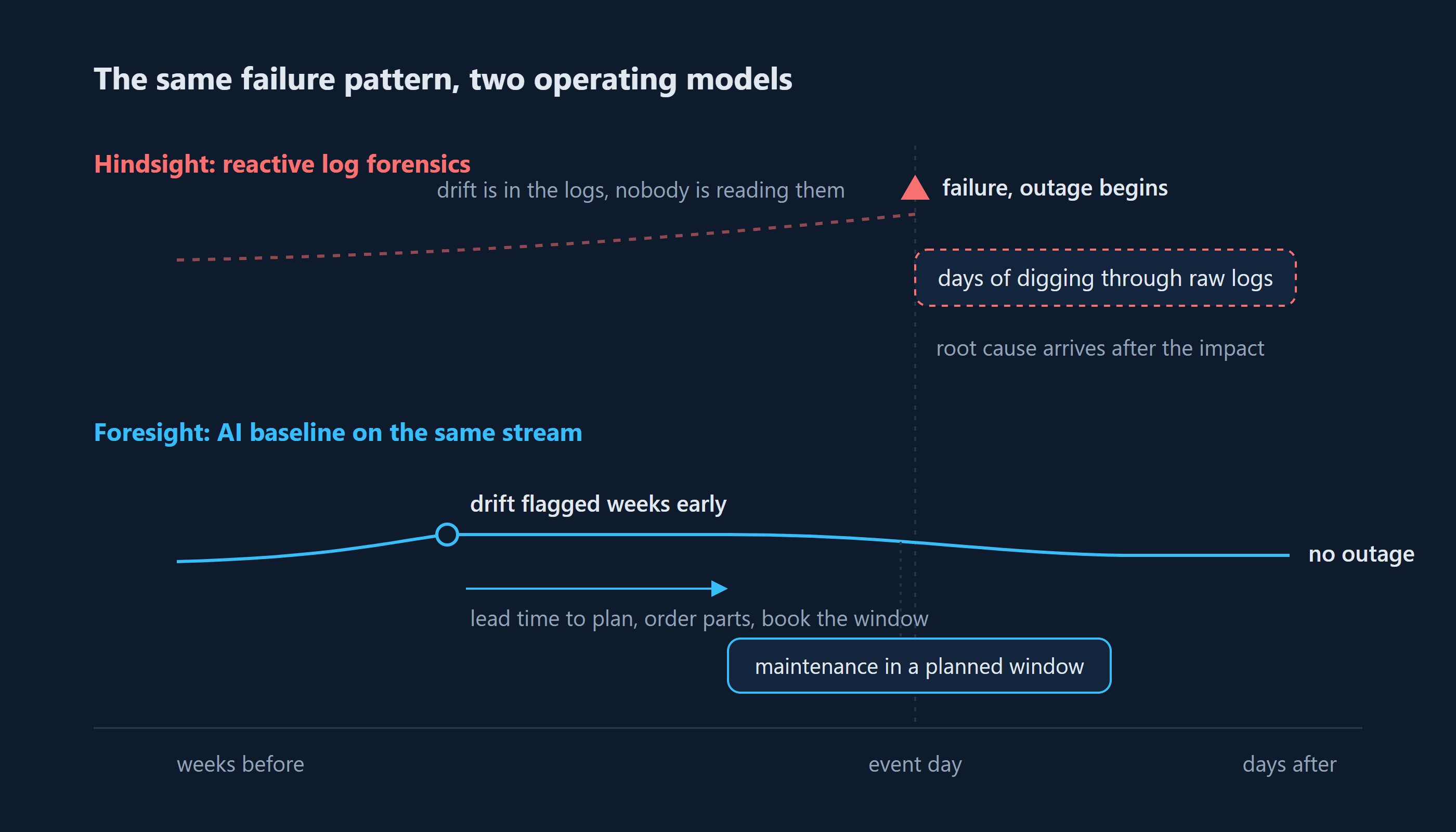
The same failure pattern on two operating models. On the top track the warning sits unread in the logs until the outage forces a forensic dig. On the bottom track the same stream, watched by a baseline model, buys weeks of lead time. Illustrative.
How do logs become a single source of truth?
The deeper transformation is what AI does to the trustworthiness of the record itself.
AI-driven pipelines normalize logs arriving in dozens of incompatible formats into one consistent structure, align timestamps, and enrich each event with contextual metadata: which asset, which location, which service, which change window. Every event is scored, classified, and verifiable, which means the integrity of the data no longer depends on whoever happened to be on shift.
That reliability compounds. Once log data is standardized, enriched, and automatically verified, it becomes strong enough to lean on: as verifiable proof in a compliance audit, as objective evidence for SLA reporting, and as the definitive timeline in a root-cause analysis. Conversations change from debating what the data means to deciding what to do about it. This is the real prize: logs elevated from operational exhaust to a trusted reference point for the entire organization.
How does Prochista put this into practice?
At Prochista Smart Technologies, this transformation is not a future promise. It is how we build.
Our operations management solutions, including ProDCIM, embed AI-driven insight directly into the infrastructure data your teams work with every day. Instead of drowning in raw telemetry, your engineers see normalized, enriched, anomaly-scored intelligence: clear explanations in place of cryptic codes, early warnings in place of surprise outages, and audit-ready records in place of diagnostic guesswork.
The outcome is a fundamentally stronger operation. Faster resolution. Fewer escalations. Confident audits. And a device log workflow your whole organization can finally treat as what it should have been all along: a reliable backbone for operational excellence.
Ready to turn your log data from noise into truth? Talk to the Prochista team and see what AI-driven operational intelligence looks like on your own infrastructure.
Prochista Smart Technologies builds AI-driven operations management solutions, including ProDCIM, that help organizations manage infrastructure data with clarity, confidence, and control.
See it on your own racks
Book a walkthrough mapped to your environment: monitoring, asset management and out-of-band resilience across every site.
More insights
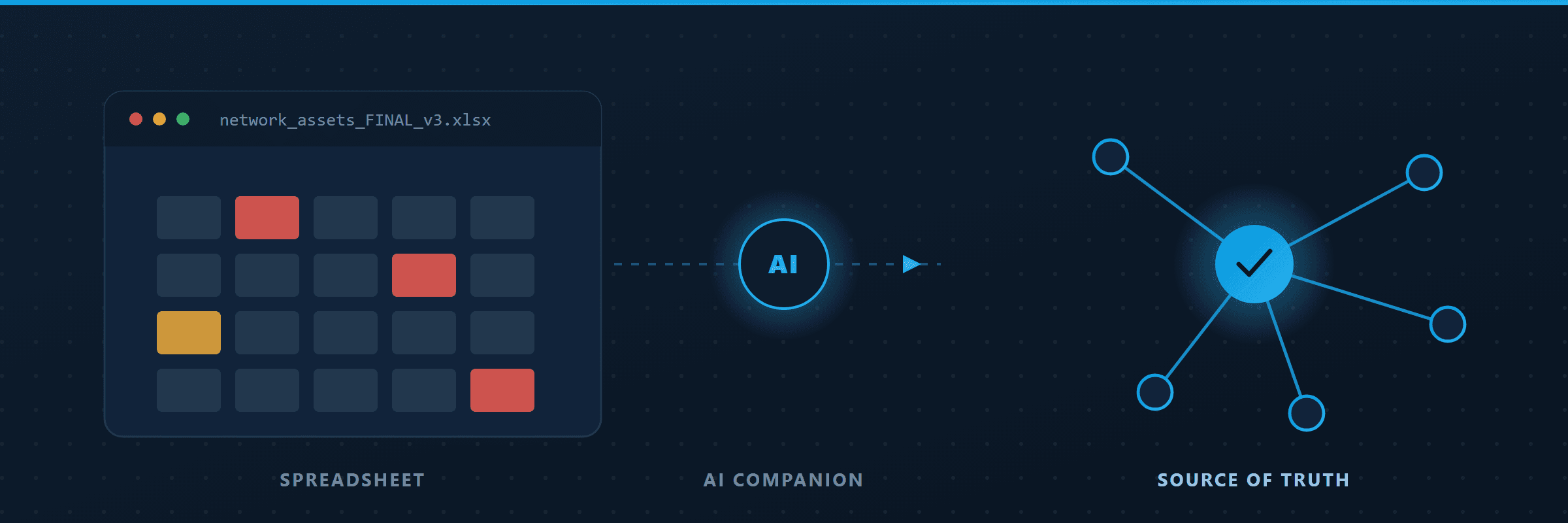
Excel for Your Server Room Is Painful, But a Traditional CMDB Can Hurt More
Your server room probably runs on network_assets_FINAL_v3.xlsx. It works until it does not, and a traditional CMDB can hurt more. Here is why that trade-off finally breaks in the AI era, and what to do instead.
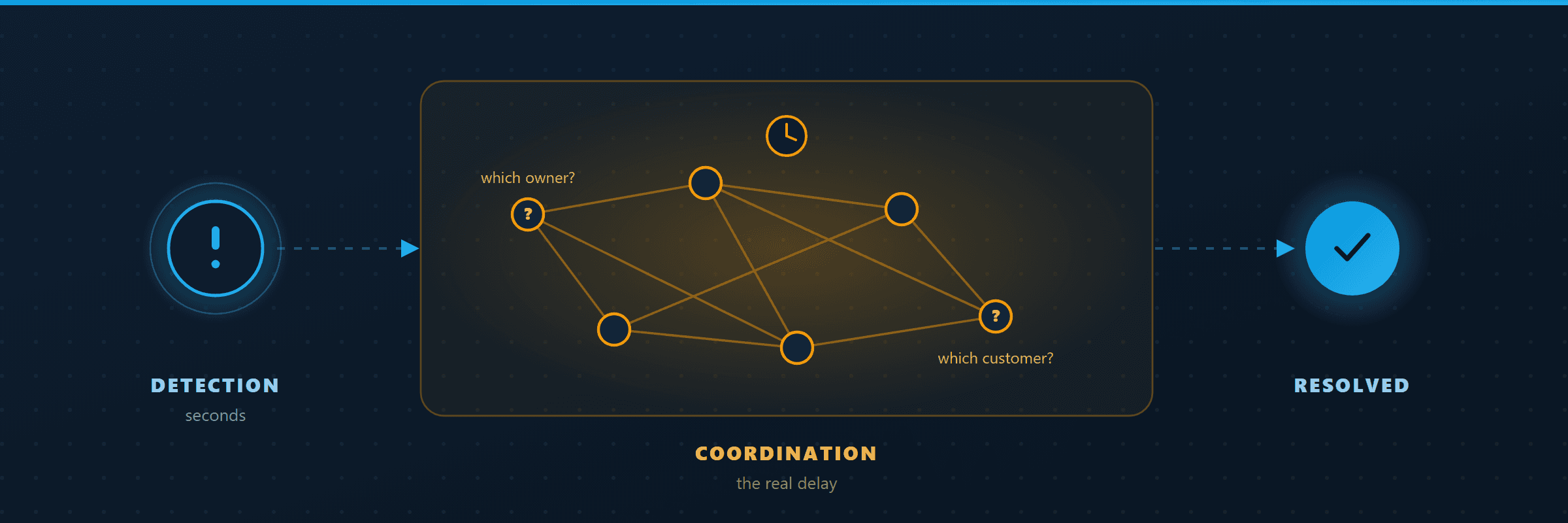
Your Data Center's Hardest Problem Isn't Detection. It's Coordination.
When an incident hits, your monitoring already knows. The real delay is everything that happens next: finding the affected customer, the right owner, the correct procedure, the required approval. ProDCIM AI Employee is built to close that gap.
Introducing the New Prochista: A New Website and Next-Generation Platform
We've unveiled a brand-new website and the next generation of our software interface, and we're kicking off a weekly deep dive into the Prochista platform, from hardware monitoring to remote-site resiliency.