
Beyond Static Thresholds: Engineering Reliability in Distributed Thermal Monitoring
Why fixed temperature alarms fail in high-density, distributed sites, and how edge-run statistical anomaly detection catches cooling failures before the heat spike.
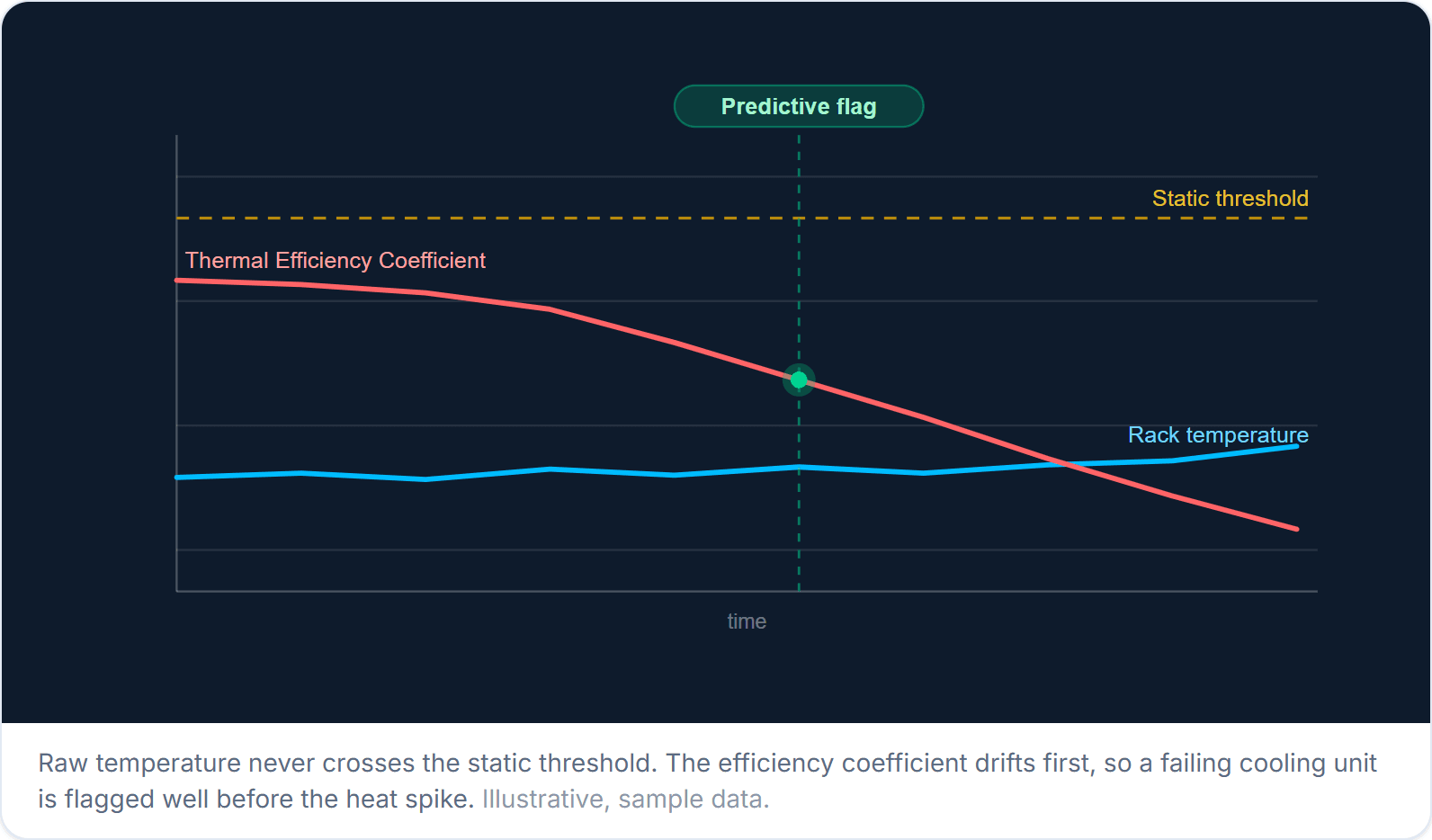
The page fires at 3:12 AM: inlet at 38°C, edge site 400 km away, and the array is already throttling. The postmortem will note that every sensor read normal until seven minutes before impact, and it will be technically true. If your remote-site monitoring still runs on if (temp > 38) alert(), the sensors are not lying, your threshold is: it watches the one number that only moves after the failure is committed.
The signal-to-noise problem
Two things break static thresholds in the field.
The sampling trap. A 60-second polling interval effectively aliases your thermal data. Short-duration heat spikes, from airflow impedance or a fan that is just starting to fail, never show up between samples. What you cannot see, you cannot alert on.
Thermal inertia versus load dynamics. Rack temperature is a moving target shaped by CPU utilization, fan RPM, and ambient intake all at once. A fixed threshold cannot tell a legitimate compute burst from a dying cooling unit, and that ambiguity is exactly what trains NOC teams to tune out alerts until it is too late.
Statistical anomaly detection, run at the edge
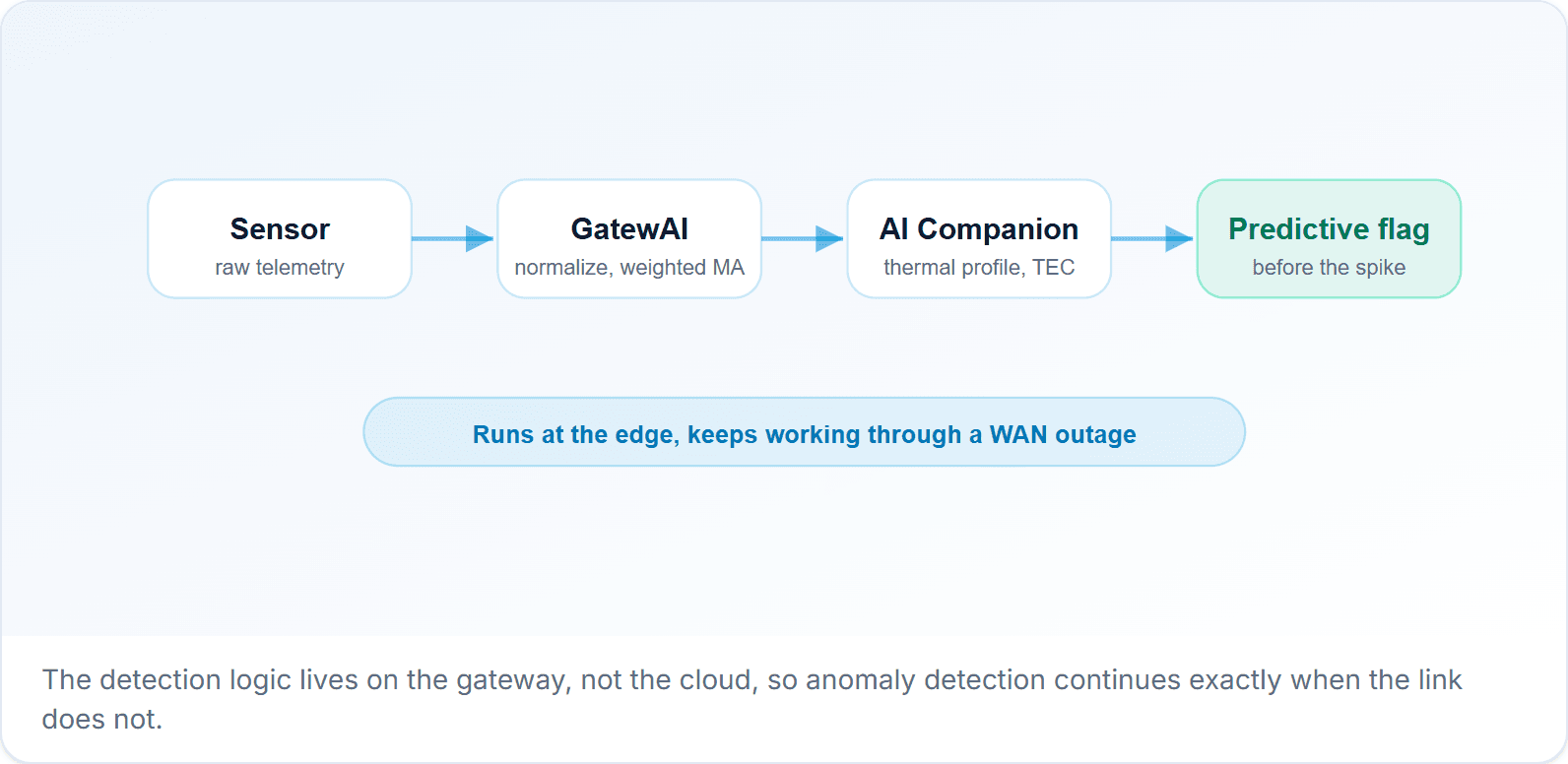
Our fix was to move the logic off the cloud and onto the gateway. GatewAI normalizes telemetry locally before it is ever transmitted, applying a weighted moving average that filters transient noise while staying sensitive to real trends.
From there, the AI Companion does not just watch absolute temperature. It builds a live thermal profile per rack, tracking the delta between CPU load and inlet temperature to produce a Thermal Efficiency Coefficient. When that coefficient drifts from baseline, even while raw temperature is still safe, the system raises a predictive maintenance flag.
In practice, that means catching a bearing failure in a cooling unit by its efficiency drop, well before it ever shows up as a temperature spike.
What this changes on the ground
- Deterministic, not heuristic. Trend analysis replaces guesswork.
- Lower MTTR. By the time a critical alert reaches your desk, it arrives with the diagnostic history attached, not just an error code.
- Survives a WAN outage. Because the detection logic runs locally, it keeps working exactly when the link does not.
Try this yourself
Plot your current temperature data against power draw. If the correlation looks inconsistent, your sensors are probably sitting in a stagnant airflow pocket. A multi-point differential pressure setup will show you the rack's true thermal load, not just a proxy for it.
See it on your own racks
Book a walkthrough mapped to your environment: monitoring, asset management and out-of-band resilience across every site.
More insights
The Data Centre Operations Job Changed in 2026. Here Is What Actually Moved.
Denser racks, fewer qualified hands, costlier outages and a verdict on AI: what the 2026 shift in data centre operations looks like from the floor, and why another dashboard will not fix it.
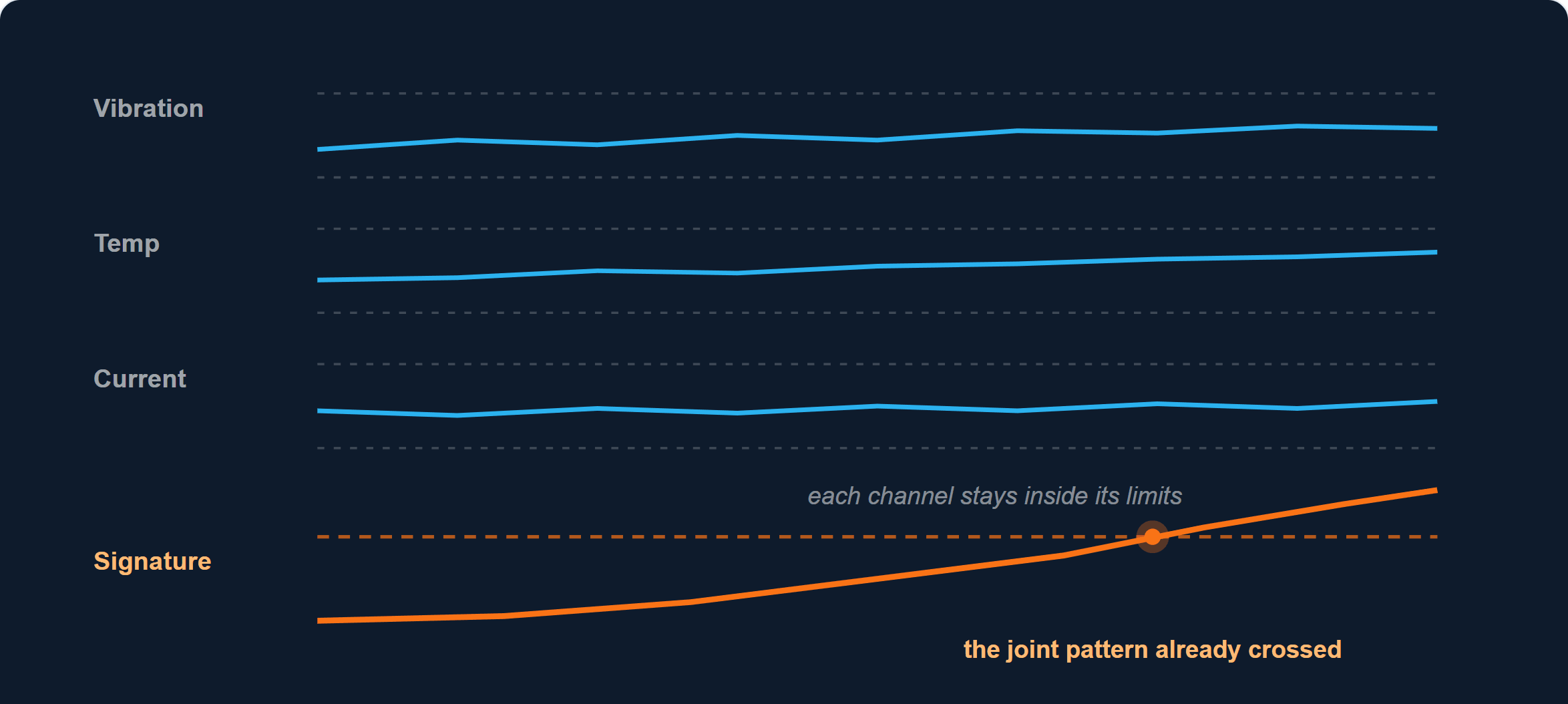
Your Equipment Told You It Was Failing. Nothing Was Listening for the Pattern.
No single parameter exceeded its limit before failure. Every reliability engineer has read that line. The failure was still legible, weeks early, in how several in-range readings moved together. On the P-F curve, condition-based pattern detection buys the lead time a fixed threshold gives away.
When the Link Dies: Why Out-of-Band Access Is the Missing Half of Monitoring
Every monitoring tool dies with the link it rides on, which means you lose visibility at the exact moment a site goes down. Out-of-band access is the missing half: a separate path home that survives the outage it's reporting. Here's how it works, what good looks like, and why it pays for itself in avoided truck rolls.