
Your Equipment Told You It Was Failing. Nothing Was Listening for the Pattern.
No single parameter exceeded its limit before failure. Every reliability engineer has read that line. The failure was still legible, weeks early, in how several in-range readings moved together. On the P-F curve, condition-based pattern detection buys the lead time a fixed threshold gives away.
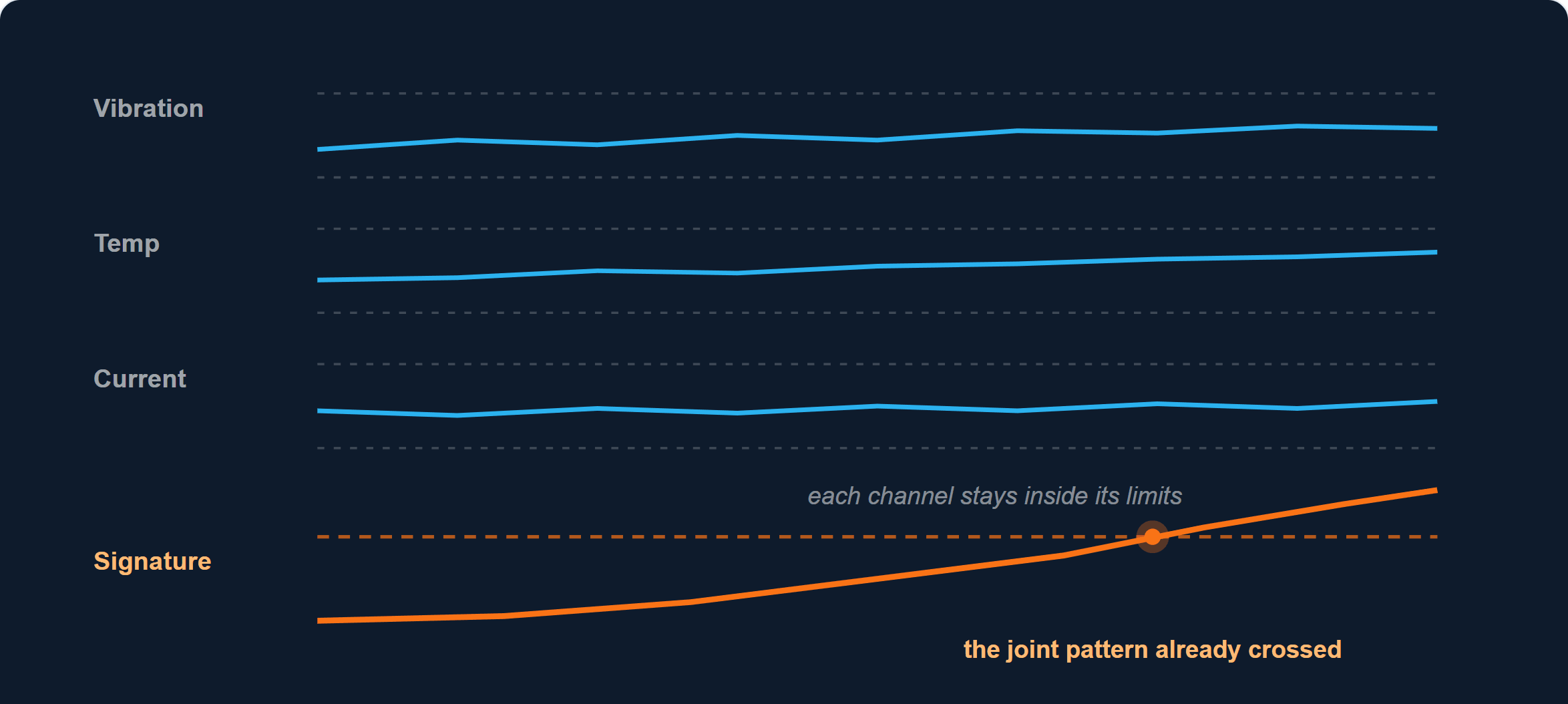
The failed part gets pulled, tagged, and sent for analysis, and the report comes back with a phrase every reliability engineer has read a hundred times: no single parameter exceeded its limit before failure. Temperature was in range. Vibration was in range. Current was in range. Each channel, read on its own, had nothing to say. Read together, they had been describing the failure for weeks.
This is the quiet limitation of threshold-based monitoring. A limit answers one question: has this number crossed this line? And it answers it one channel at a time. But most equipment does not fail by having a single number go out of bounds. It fails by having several in-bounds numbers start moving in a way they never did when the machine was healthy. Watch each of them separately and you will miss it, right up until the point where watching stops mattering.
A threshold is a very late alarm
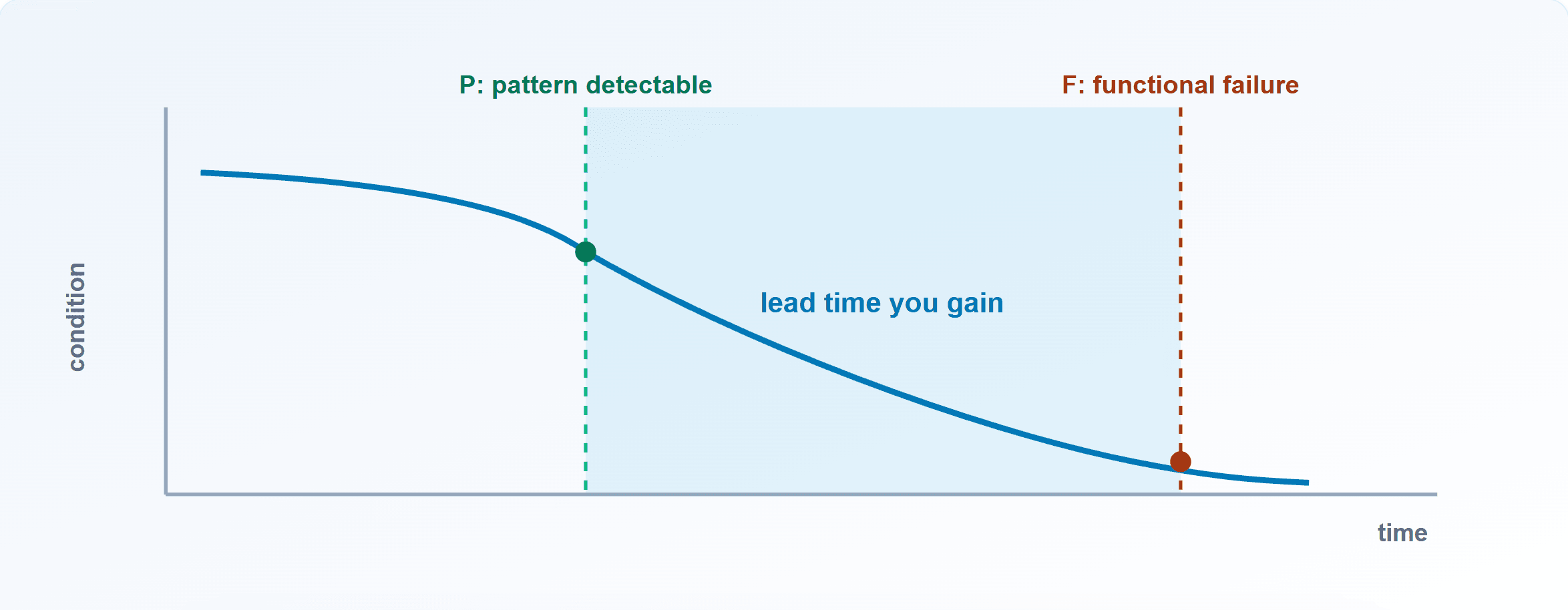
Reliability engineering has a name for the runway you are working with: the P-F interval, the gap between the moment a failure first becomes detectable and the moment the equipment actually stops doing its job. A fixed limit is tuned to trip near the end of that runway, close to functional failure, because that is where a single parameter finally leaves its band. The useful information, and most of the runway, sits earlier, in the part of the curve where nothing has crossed a line yet but the behavior has clearly changed.
Failure has a signature, not a number
Degradation announces itself as a change in relationships, not a lone spike. A bearing on its way out shifts its vibration harmonics relative to shaft speed. A failing thermal interface shows up as temperature rising for a given load, not as an absolute record. A tiring capacitor or an aging battery reveals itself as growing ripple or a slower recovery under the same discharge it handled cleanly last quarter. In every case the information is carried in the correlation between channels, which is exactly the thing a per-channel limit is structurally unable to see.
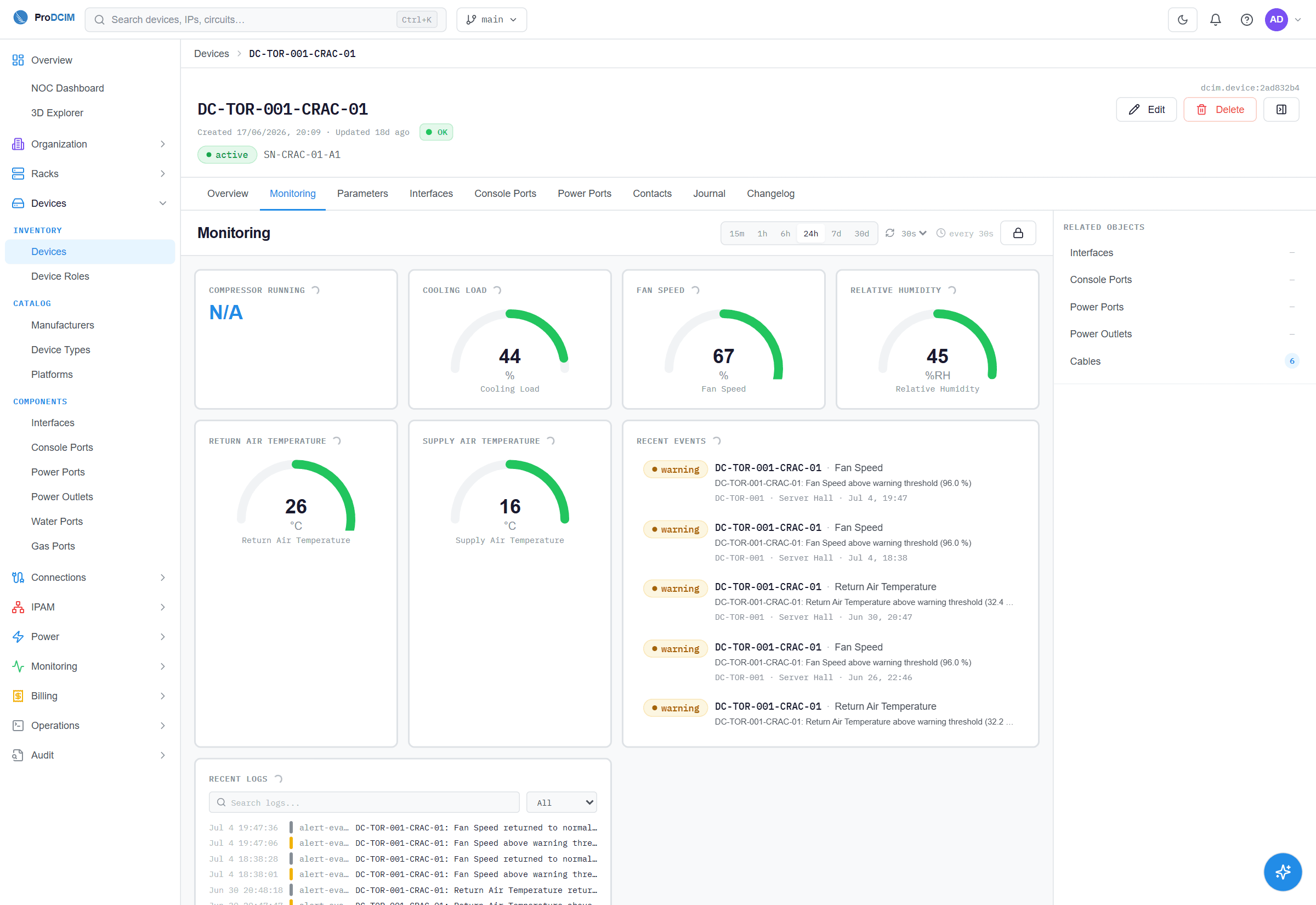
We have watched this play out on live equipment: a cooling unit whose return and supply air read safe for days while fan-speed warnings quietly stacked up in the event log, the fan compensating for efficiency the unit was losing. That incident, and why static limits missed it, is walked through in Beyond Static Thresholds.
Why the window matters
The P-F interval is not a curiosity; it is your planning budget, and how early you can recognize the pattern determines how much of it you get to spend. Catch degradation near its potential-failure point and a failure becomes a part swap in a scheduled maintenance window, with the replacement already staged. Catch it near functional failure and the same event is an unplanned outage plus emergency labor plus whatever it took down with it. Same component, same physics: the entire difference is lead time.
It only works if you kept the data
There is a catch, and it points back at the instrumentation. A signature has to be learned: from history, across several channels, time-aligned, at a resolution that matches how fast the failure develops. Sparse single-variable logs sampled slowly cannot train a multivariate model and cannot be matched against one, because the relationships that carry the signal were never recorded in the first place. Prediction is only as good as the continuous, multi-channel history underneath it. You cannot recognize a pattern in data you threw away.
What it takes to hear the pattern
Solving this takes three moves, in order.
- 1Collect continuous, time-aligned multivariate telemetry at a resolution matched to the timescale of the failure modes you care about. This is the raw material for any signature.
- 2Model the normal relationships between those channels and detect drift toward known failure signatures, rather than checking each channel against a fixed limit.
- 3Act on the pattern, not the ping: turn a recognized signature into a ranked, explained work order with the contributing signals attached, instead of one more raw alarm in the queue.
Stated plainly, moving from reactive to predictive maintenance requires software that stores multivariate time-series history and runs pattern and anomaly models over it: condition-based, not threshold-based. Thresholds are not wrong, they are just late, and late is expensive at the moment they finally fire.
This is the gap ProDCIM is built around. It records continuous, time-aligned telemetry across power, cooling, and environmental channels and keeps the history that signatures are learned from. Its AI Companion models each asset's normal behavior so drift gets flagged, with the contributing signals attached, while every individual reading still looks safe. The equipment has been talking the whole time. Hearing it is a matter of running something that listens to the channels together.
See it on your own racks
Book a walkthrough mapped to your environment: monitoring, asset management and out-of-band resilience across every site.
More insights
The Data Centre Operations Job Changed in 2026. Here Is What Actually Moved.
Denser racks, fewer qualified hands, costlier outages and a verdict on AI: what the 2026 shift in data centre operations looks like from the floor, and why another dashboard will not fix it.
Beyond Static Thresholds: Engineering Reliability in Distributed Thermal Monitoring
Why fixed temperature alarms fail in high-density, distributed sites, and how edge-run statistical anomaly detection catches cooling failures before the heat spike.
When the Link Dies: Why Out-of-Band Access Is the Missing Half of Monitoring
Every monitoring tool dies with the link it rides on, which means you lose visibility at the exact moment a site goes down. Out-of-band access is the missing half: a separate path home that survives the outage it's reporting. Here's how it works, what good looks like, and why it pays for itself in avoided truck rolls.