
Liquid Cooling Is Arriving Faster Than the Skills to Run It
More than 80 percent of operators have never run a rack above 30 kW, and the typical facility rack sits near 9 kW. The GPU loads arriving now run far hotter, on pumped liquid, with seconds of thermal ride-through instead of minutes. The hardware will arrive on schedule. Here is the four week program that gets the team ready before it does.
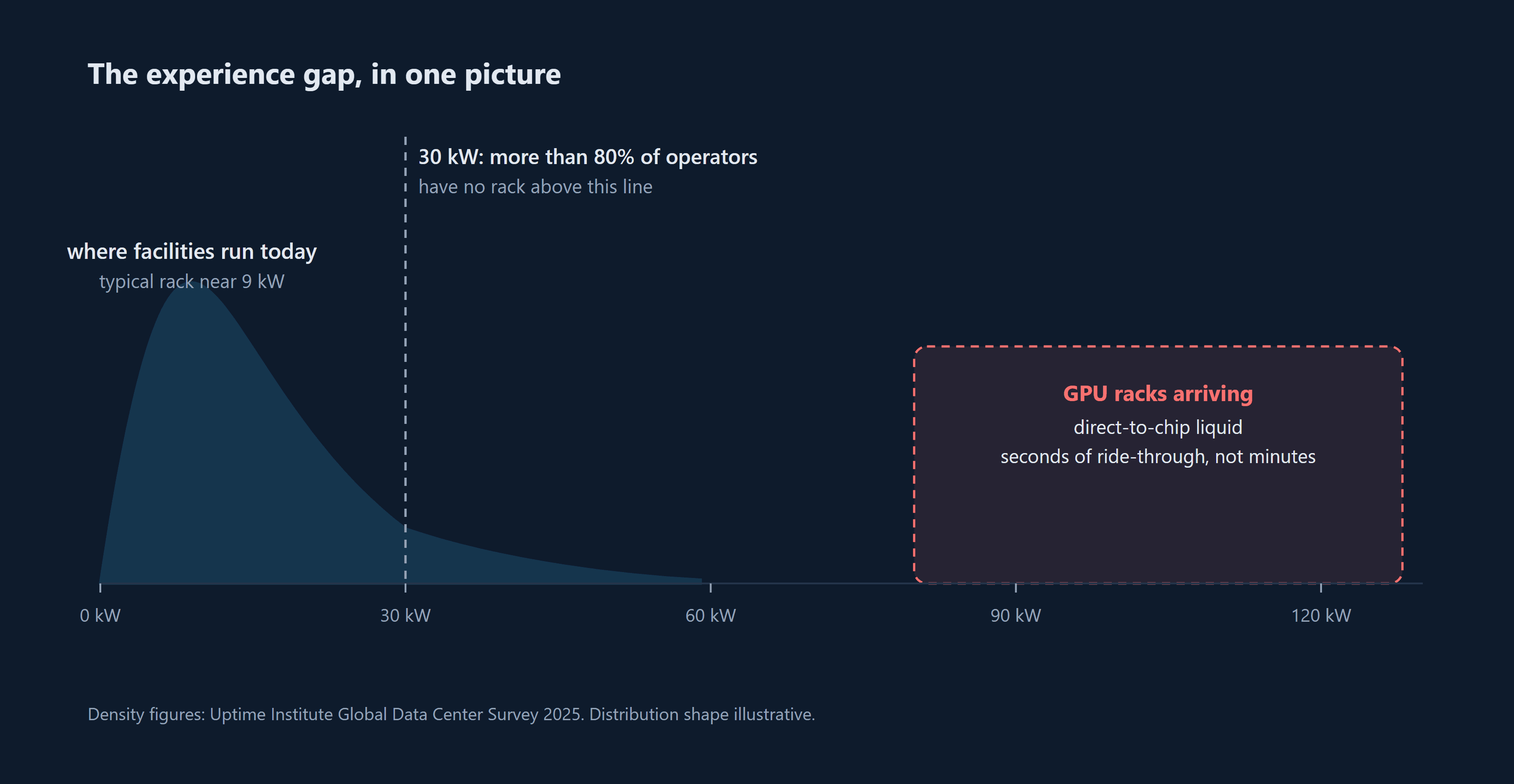
The gap nobody put on the project plan
There is a number in the Uptime Institute's 2025 Global Data Center Survey that we keep coming back to. More than 80 percent of operators say their facility has no rack drawing above 30 kW. Roughly one in eight reports anything at all in the 30 to 59 kW band. The average modal density across the sample sits close to 9 kW.
Read that next to the GPU deployments being announced every week and the picture gets uncomfortable. The experience base for high-density liquid cooling does not exist yet in most rooms, because the load has not arrived in most rooms. It is about to.
Our engineers have watched the same sequence play out several times in the last eighteen months. The mechanical contractor finishes. The commissioning agent runs the scripts and signs off. The CDU is pressure tested, the manifolds are leak checked, the documentation is thick and correct. And then the room is handed to a team who have spent fifteen years reading temperature deltas across a hot aisle, and who are now responsible for a pumped fluid loop running centimeters above live electronics.
Nobody put that gap on the project plan. It does not appear in the schedule, the budget, or the commissioning report. It appears eight weeks later, at two in the morning, when a differential pressure alarm goes off and the person on shift cannot tell whether it is a loading filter, a failing pump, or a valve somebody nudged during a rack install.
This is a procedures problem, and procedures problems are measurable
If that sounds overstated, look at where outages actually come from.
Uptime's Annual Outage Analysis 2026 found that failure to follow established procedures remains the leading driver of human error related outages. Inconsistent or unclear processes sit close behind, alongside installation and in-service errors. In the previous year's edition, the share of human error outages traced to procedure failures had risen by ten percentage points in a single year.
That is not a story about careless technicians. It is a story about procedures that were never written for the system actually installed, or that were written generically by a vendor and never localized to the site.
The staffing numbers offer no escape route either. In the same 2025 survey, 46 percent of operators said they could not find qualified candidates for open roles and 37 percent said they struggled to retain the people they had, with close to two thirds reporting one or the other. For the first time, operations management ranked as the job category with the widest skills gap, cited by 39 percent of operators. The senior people who would normally absorb a new technology and teach it downward are exactly the people who are hardest to hire right now.
You are not going to buy this capability off the market. You are going to have to build it in house.
What actually changes when the fluid arrives
Before the training, it is worth being precise about what is new, because liquid cooling is not one change. It is four.
The system splits in two. ASHRAE's liquid cooling guidance is built around a clean demarcation between the Facility Water System and the Technology Cooling System, with the CDU sitting between them as the isolation point. Two loops, two sets of operating parameters, two sets of fluid requirements, and one piece of equipment that has to be understood from both sides. Most air-trained teams carry a mental model with a single loop in it.
Fluid quality becomes an operating parameter. ASHRAE TC 9.9 defines water quality classes, and the requirements on the technology side are considerably tighter than on the facility side. Let the chemistry drift and you get biological growth, corrosion and scaling, which present first as a slow efficiency loss and later as a restricted cold plate. The Open Compute Project has landed on a 25 percent propylene glycol mix as its recommended direct-to-chip coolant, largely because it is more forgiving to manage than deionized water. Either way, sampling becomes a scheduled maintenance task rather than a commissioning formality.
Your ride-through gets much shorter. ASHRAE recommends designing in thermal inertia and active redundancy precisely because a liquid-cooled high-density rack has very little thermal mass to coast on. An air-cooled hall gives you minutes to think during a changeover. A cold plate under a heavy GPU load gives you seconds. That changes what an emergency procedure has to look like and how quickly it has to be executed.
The failure mode now includes water. This is the one that changes behavior more than any other. A leak is not only a cooling event, it is an electrical one, and the response has to be rehearsed rather than reasoned out on the night.
A four week program you can actually run
Here is the training we would put in place before any high-density load goes live. It is deliberately modest: four weeks, part time, run by your own team on your own system, not a vendor classroom in another city. Every week produces an artifact you can point at during a handover review.
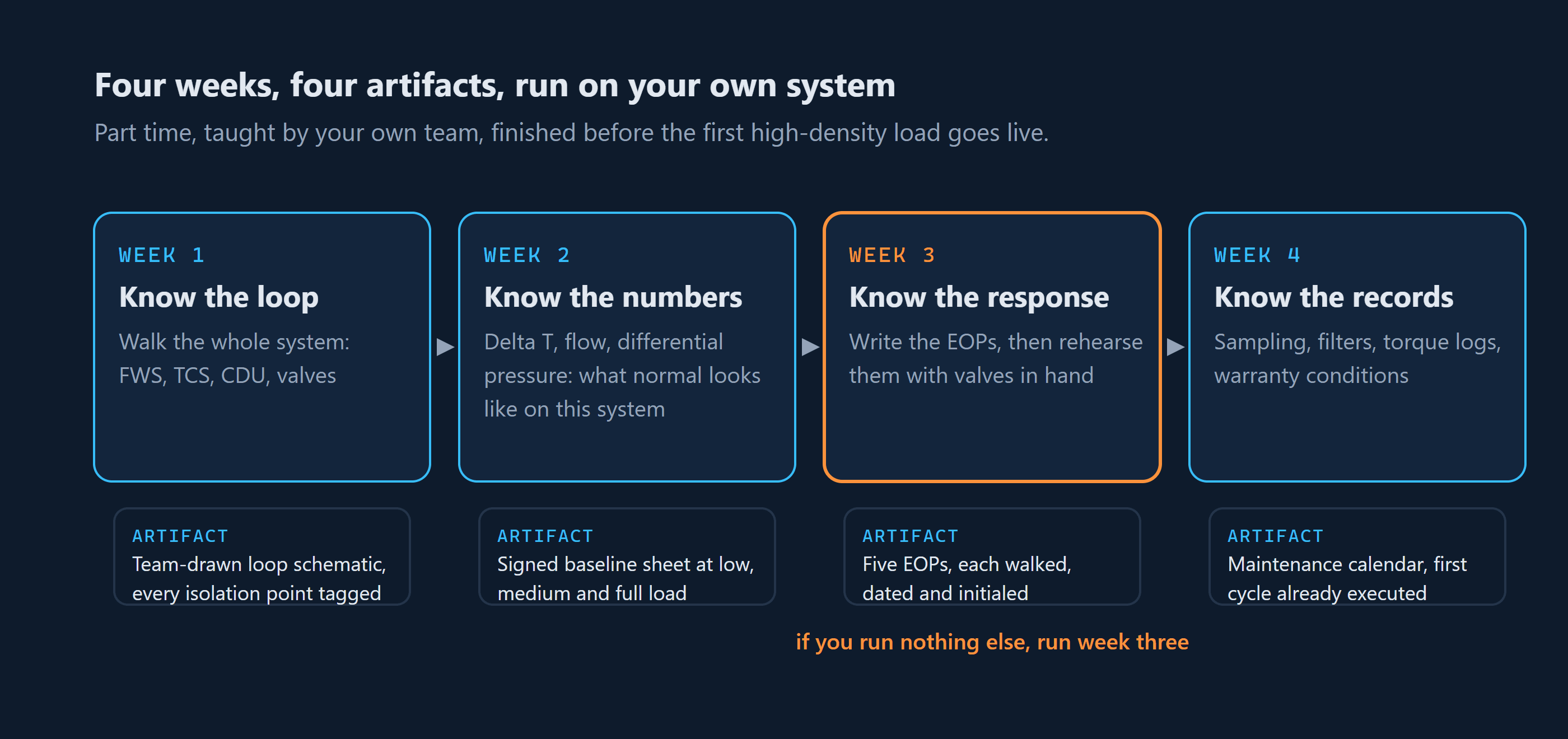
Four weeks, part time, on your own system. Each week ends with an artifact a handover review can inspect. If you run only one week, run week three. Illustrative.
Week one. Know the loop. Walk the entire system physically, not on a drawing. Facility side, technology side, CDU, manifolds, quick disconnects, cold plates, every isolation valve and every drain point. Each technician traces the path of a liter of coolant end to end and marks it up themselves. Artifact: a one-page loop schematic drawn by the team, with every isolation point numbered and labeled to match the physical tags in the room.
Week two. Know the numbers. Supply temperature, return temperature, delta T, flow rate, differential pressure, approach temperature, fluid conductivity. What each one means, which ones move together, and what normal looks like on this system at this load. Not on a datasheet. On this system. Artifact: a signed baseline sheet recording each parameter at low, medium and full load, with alarm thresholds derived from those readings rather than inherited from a vendor default.
Week three. Know the response. Write the emergency procedures, then rehearse them. Leak at a quick disconnect. Loss of flow to a single rack. CDU pump failure. Loss of facility water. Loss of power during a changeover. Each one gets a written EOP with a named first action, and each one gets walked in the room with the actual valves in hand. Artifact: five EOPs, each rehearsed at least once, each walkthrough dated and initialed by the technicians who performed it.
Week four. Know the records. Fluid sampling schedule and how to read the results. Filter change intervals, and what a rising differential pressure across a filter is telling you. Torque and inspection records on connections. Warranty conditions, which almost always hinge on demonstrating that the fluid regime was maintained. Artifact: a completed maintenance calendar with named owners and the first full cycle already executed.
If you run nothing else, run week three. Uptime's outage data says procedure failure is the leading human error cause of outages, and an unrehearsed procedure is functionally the same as no procedure.
Make the instrumentation part of the curriculum
Week two quietly determines whether the rest of it sticks, and it is also the hardest week to teach in a classroom. Pattern recognition is not a lecture. Somebody learns what a healthy loop looks like by watching a healthy loop for a few hundred hours and then noticing when it stops being one.
That only works if the data sits somewhere they will actually look. In most installations it does not. The CDU has a perfectly capable local controller with a small screen in a hot aisle. The BMS holds the facility water side. The DCIM holds power and IT load. None of them share a timeline. So a technician who wants to know whether a delta T shift matters has to correlate three systems by hand, and mostly will not bother.
Put the fluid telemetry on the same screen and the same timeline as rack power and IT load, and the learning curve compresses sharply. A rise in return temperature that tracks a workload ramp is normal. The same rise against flat IT load is a flow problem. That distinction is obvious when the two curves are stacked and close to invisible when they are not.
This is the pattern we built into ProDCIM's monitoring layer at Prochista: pulling CDU and fluid loop telemetry into the same view as power, environmental and IT metrics, so the loop is trended rather than merely alarmed.
The handover test
We would replace "is the system commissioned" with a different question at handover.
Pick a technician at random from the shift roster. Ask them to point at the isolation valve that would take a single rack off the loop, tell you the current delta T and whether it is normal, and describe the first three actions on a leak at a quick disconnect.
If they can do it, the room is ready. If they cannot, the room is mechanically complete and operationally exposed, and no vendor support contract changes that. Vendor support is a backstop. It is not ownership.
The industry is about to introduce a great deal of liquid into rooms that have never had any. The hardware will arrive on schedule. The competence has to be scheduled separately.
Preparing your first liquid-cooled deployment? Talk to the Prochista team about putting CDU and fluid-loop telemetry on the same screen as your power and IT load, before the first rack lands.
Sources: Uptime Institute, Global Data Center Survey 2025 (rack density distribution; hiring, retention and skills gap by job category). Uptime Institute, Annual Outage Analysis 2026 and 2025 (human error and procedure-related outage causes). ASHRAE Technical Committee 9.9, liquid cooling guidelines (FWS and TCS demarcation, CDU role, water quality classes, thermal inertia and redundancy). Open Compute Project coolant guidance (25 percent propylene glycol for direct-to-chip).
Prochista Smart Technologies builds AI-driven operations management solutions, including ProDCIM, that help organizations manage infrastructure data with clarity, confidence, and control.
See it on your own racks
Book a walkthrough mapped to your environment: monitoring, asset management and out-of-band resilience across every site.
More insights
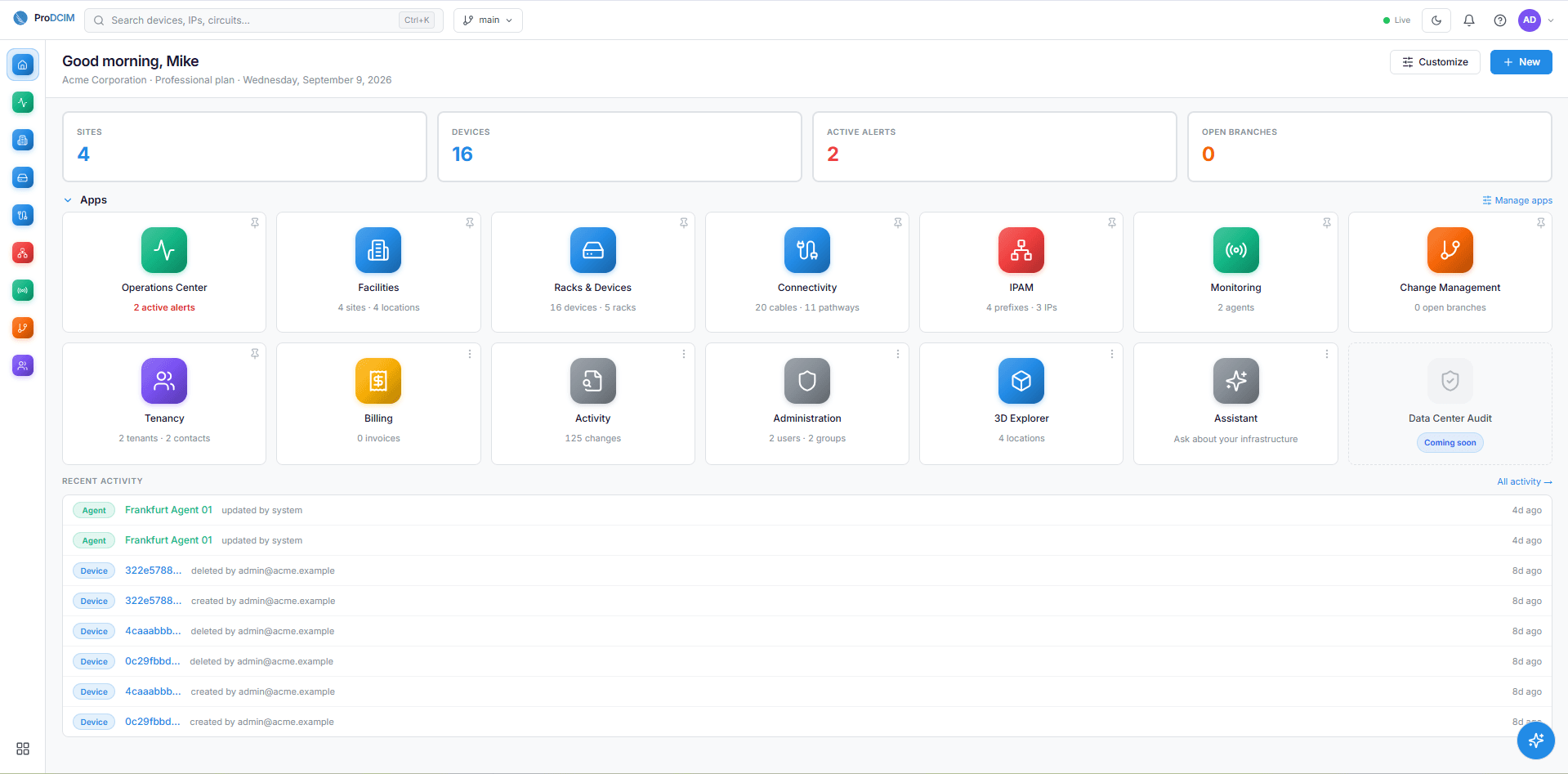
Why does it take so long to find the equipment behind an alert?
A PDU circuit crossing 80 percent names a circuit, not a device. When the floor plan, the asset register and the power readings live in separate systems, closing that gap is the slowest part of the shift. Here is what changes when they share one model of your infrastructure.
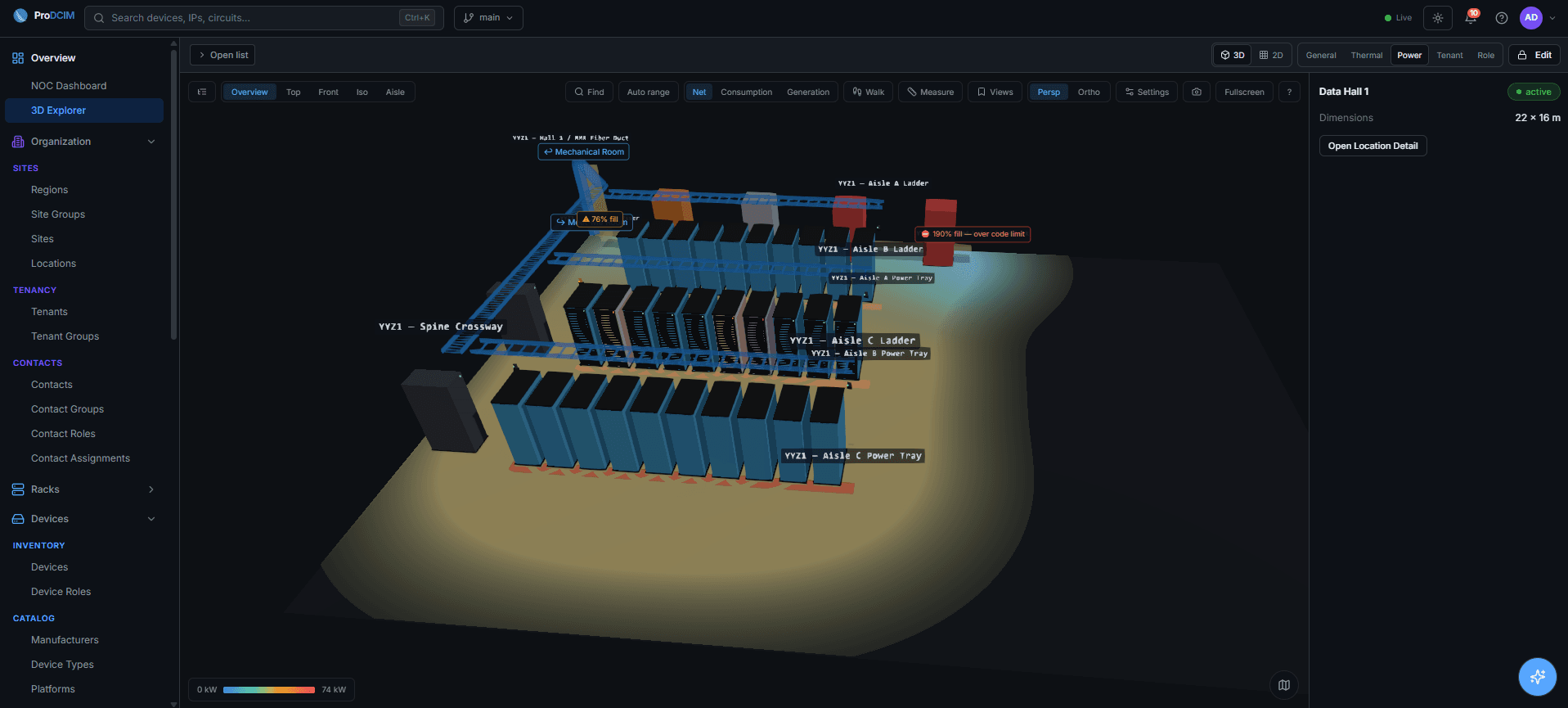
Racks Are Getting Denser. Confidence in the Data Is Not.
Uptime Institute's 2026 survey shows racks at 50 kW or more rose from 10 to 13 percent in a year, while racks under 10 kW fell from 32 to 25 percent. Over the same period operators reported the least confidence in the completeness of their operational data, which is the property that decides whether you can act on it.
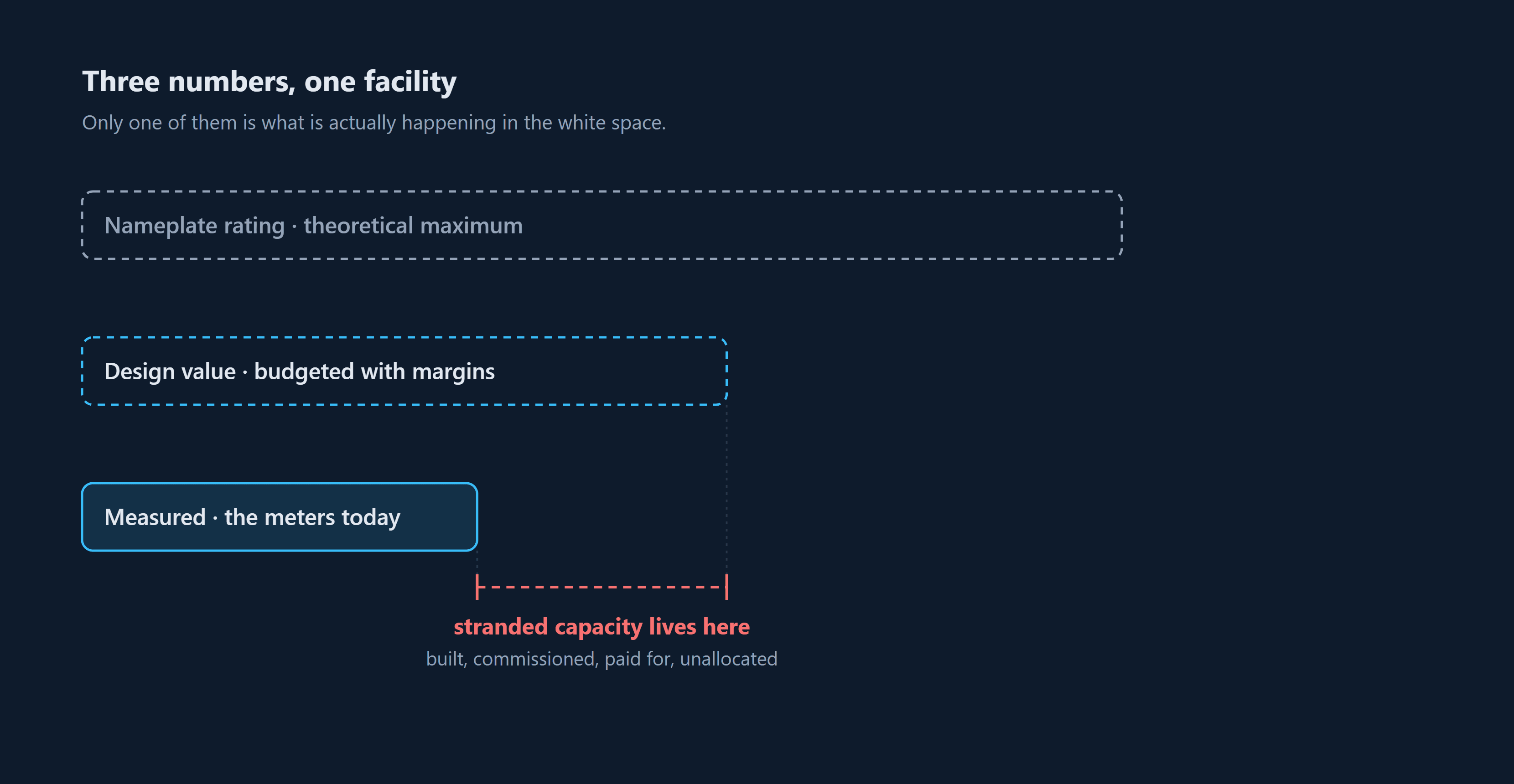
Nameplate vs. Reality: How Data Centers Can Reclaim Stranded Power
Most data centers have more usable power than their spreadsheets admit. It sits stranded between conservative design assumptions and what the meters actually show. Reclaiming it takes measurement, not retrofits: branch-circuit telemetry, high-percentile planning baselines, and headroom modeled under N-1. Here is the playbook.