
Nameplate vs. Reality: How Data Centers Can Reclaim Stranded Power
Most data centers have more usable power than their spreadsheets admit. It sits stranded between conservative design assumptions and what the meters actually show. Reclaiming it takes measurement, not retrofits: branch-circuit telemetry, high-percentile planning baselines, and headroom modeled under N-1. Here is the playbook.
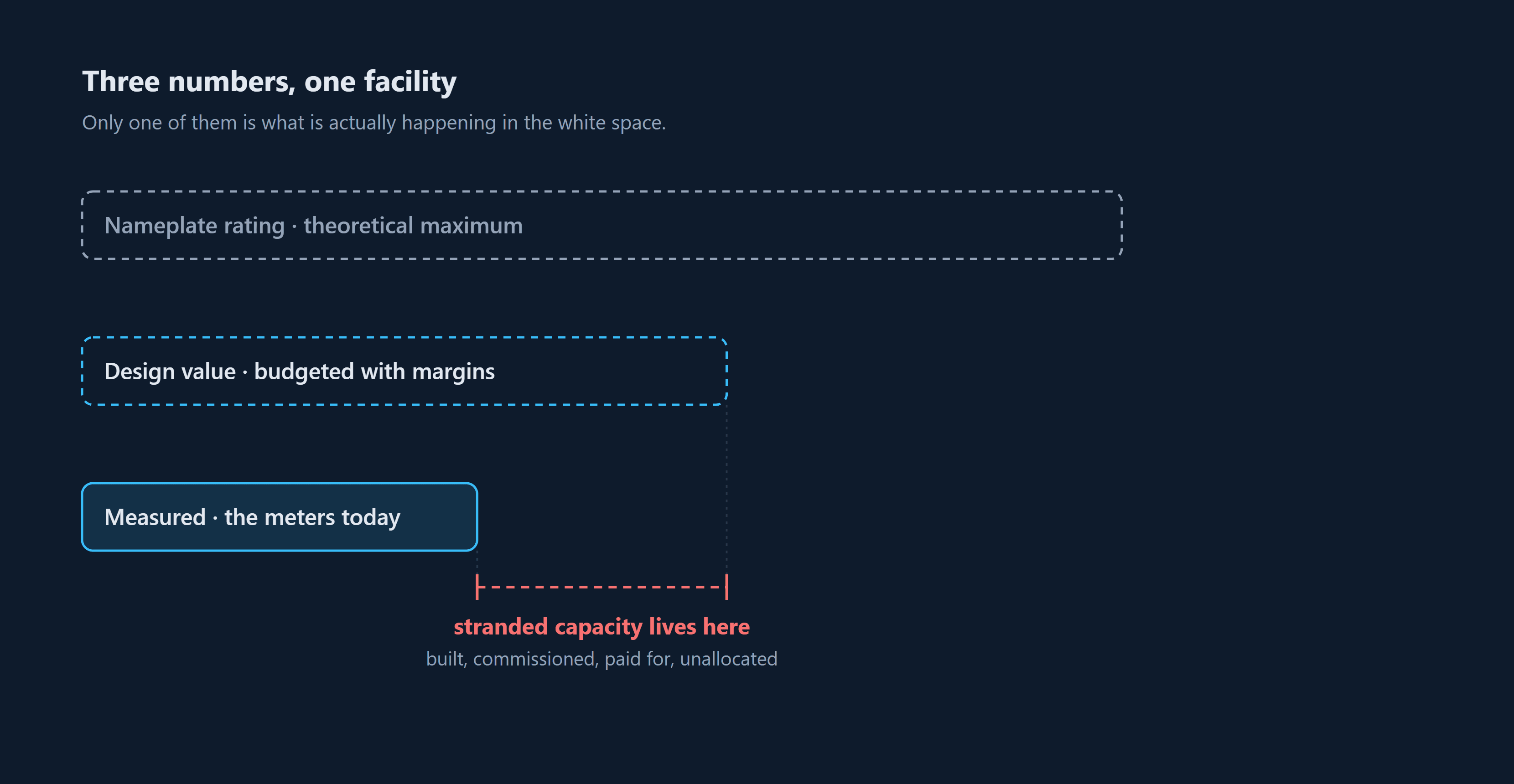
Most data centers have more usable power than their spreadsheets admit. The capacity is real, built, commissioned and paid for; it is stranded between conservative design assumptions and what the meters actually show. Reclaiming it does not take new utility drops or retrofits. It takes measuring where decisions happen, planning from observed demand instead of nameplate ratings, and modeling headroom the way it behaves during a failure, not on a calm Tuesday.
Every data center operates on three distinct numbers:
The nameplate rating. What hardware could draw under theoretical, maximum load in a test environment.
The design value. What engineers budgeted after layering in derating factors, diversity assumptions, safety buffers, and redundancy margins.
The measured value. What the meters actually register on a typical Tuesday afternoon.
Every facility tracks all three, but only the measured value tells you what is actually happening across your white space. The gap between these numbers is where stranded capacity lives: expensive power infrastructure you have already built, commissioned, and paid for, yet cannot allocate, because capacity decisions are still constrained by static, worst-case assumptions.
How big is the gap between design and reality?
This disconnect is neither isolated nor minor. Two recent industry benchmarks show how widespread over-allocation has become.
Utility forecasters are discounting requests. In its data center load forecast, the California Energy Commission estimates data center peak load at just 67% of connected capacity, a utilization factor drawn from Silicon Valley Power's operational reviews of live sites. Even the utilities planning the grid recognize that design requests rarely match real-world draw.
UPS systems are underutilized. Uptime Institute's 2024 global survey found that one in four data centers typically runs below 40% of its available UPS capacity.
When power delivery is constrained and capital expenditure is high, managing facilities on conservative design margins alone leaves significant compute density, and the revenue attached to it, on the table.
How do you reclaim stranded capacity?
Closing the gap does not require physical retrofits. It requires closing the operational visibility gap through four data-driven habits.
1. Measure where decisions happen. Site-level visibility at the main incoming breaker only confirms high-level stability. It cannot tell you whether cabinet 14 in row B can safely accept another 3 kW. Safe densification requires granular telemetry down to the branch circuit and the rack PDU.
2. Base allocations on observed demand. Static ratings do not account for dynamic workloads. Track rolling high-percentile demand (the 95th or 99th percentile) by device class over meaningful operational windows. A full seasonal cycle is a far more reliable planning baseline than a one-week snapshot.
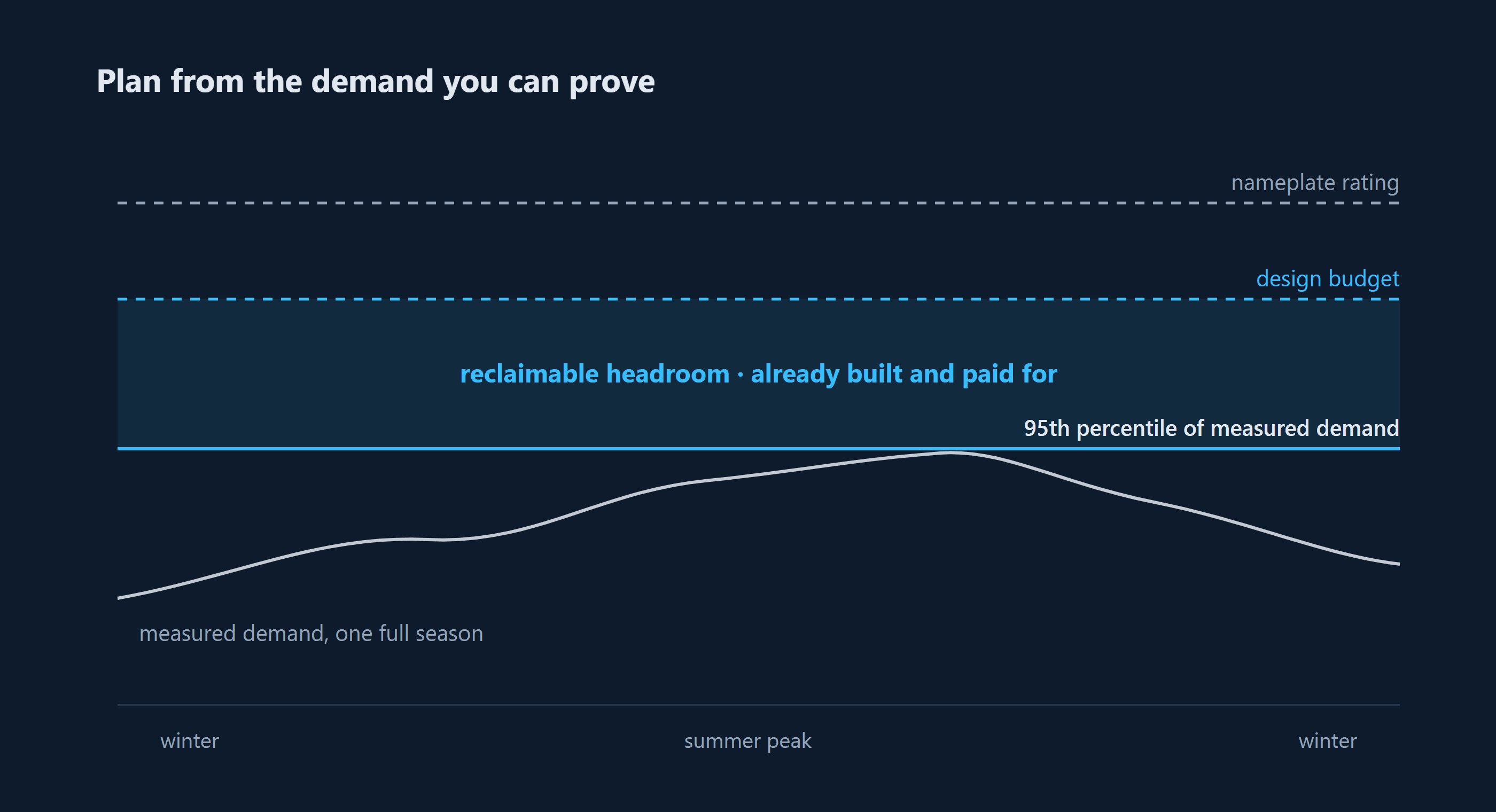
The planning baseline that matters is the high-percentile line of what the estate actually draws across a season. The band between that line and the design budget is capacity already paid for. Illustrative.
3. Model usable headroom under N-1 conditions. True available capacity is never what is free during smooth, nominal operation. Usable headroom is what remains safe and compliant when an upstream feed, transformer, or cooling circuit fails and the facility shifts onto its N-1 redundancy path.
4. Audit legacy derating multipliers. Blanket derating factors written for servers deployed five or eight years ago rarely match the efficiency profiles, power supply characteristics, or throttling behavior of modern compute hardware. Keeping those assumptions current prevents artificial bottlenecks.
What changes when the numbers become defensible?
When capacity management moves from static formulas to continuous measurement, power stops being an educated guess buried in a spreadsheet. It becomes a reliable, transparent metric that operators can defend in front of customers, auditors, engineering peers, and financial leadership.
This operational philosophy is central to ProDCIM. By combining vendor-agnostic software with industrial data acquisition, the platform calculates live headroom directly from branch-circuit telemetry and models N-1 constraints alongside normal operating paths.
Data center capacity should not be defined by what equipment might draw on paper. It should be governed by what your infrastructure can safely deliver today.
Want to see the headroom hiding in your own white space? Talk to the Prochista team and we will show you live headroom calculated from your own branch circuits.
Prochista Smart Technologies builds AI-driven operations management solutions, including ProDCIM, that help organizations manage infrastructure data with clarity, confidence, and control.
See it on your own racks
Book a walkthrough mapped to your environment: monitoring, asset management and out-of-band resilience across every site.
More insights
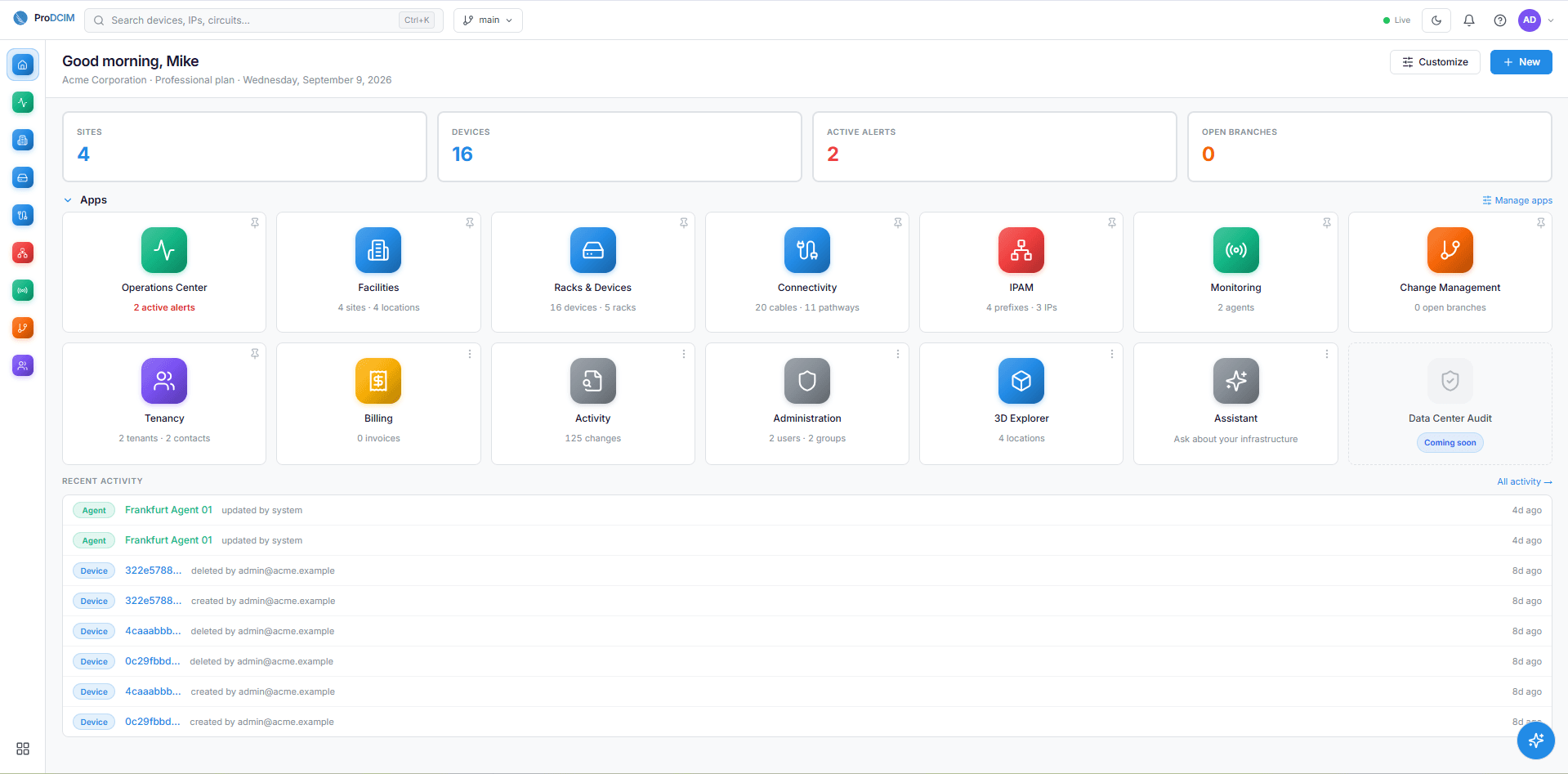
Why does it take so long to find the equipment behind an alert?
A PDU circuit crossing 80 percent names a circuit, not a device. When the floor plan, the asset register and the power readings live in separate systems, closing that gap is the slowest part of the shift. Here is what changes when they share one model of your infrastructure.
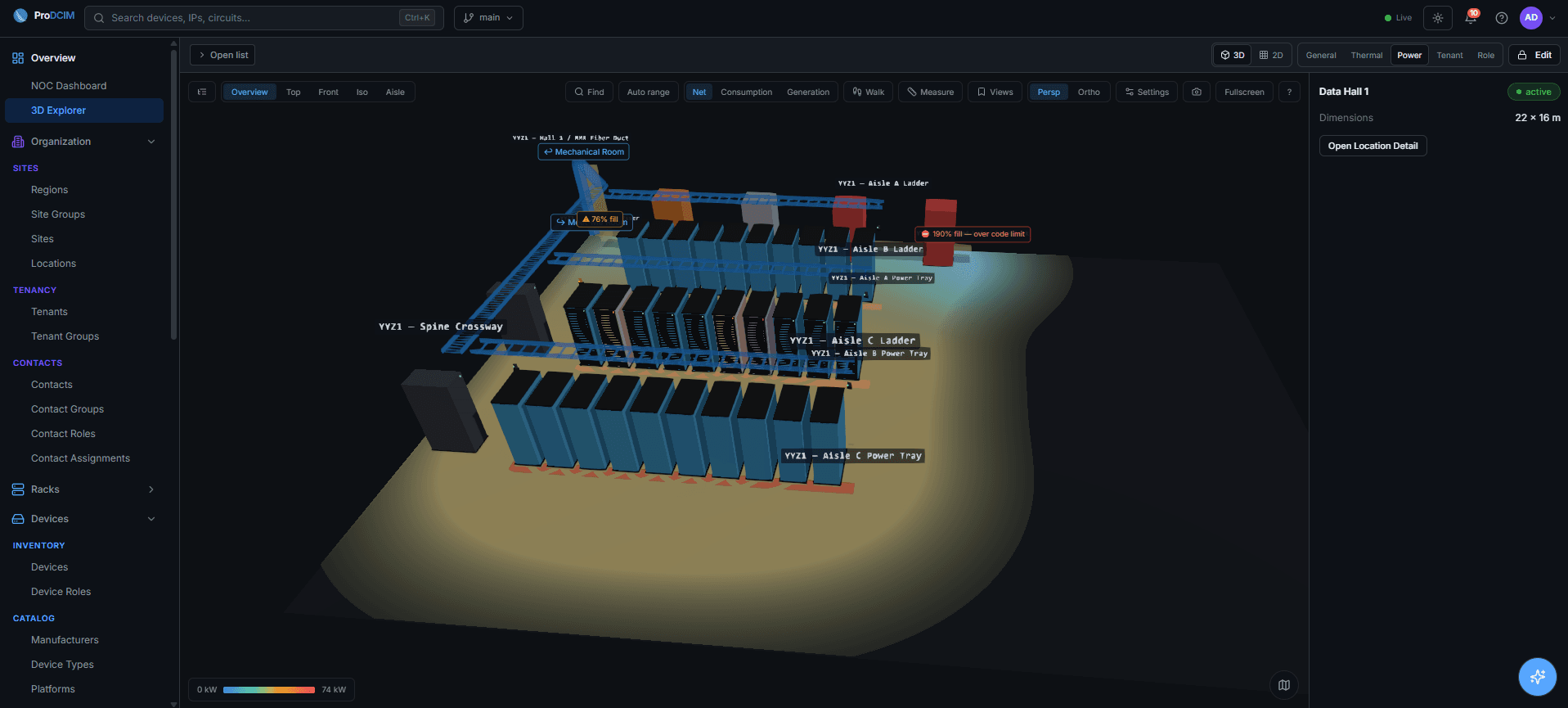
Racks Are Getting Denser. Confidence in the Data Is Not.
Uptime Institute's 2026 survey shows racks at 50 kW or more rose from 10 to 13 percent in a year, while racks under 10 kW fell from 32 to 25 percent. Over the same period operators reported the least confidence in the completeness of their operational data, which is the property that decides whether you can act on it.
Liquid Cooling Is Arriving Faster Than the Skills to Run It
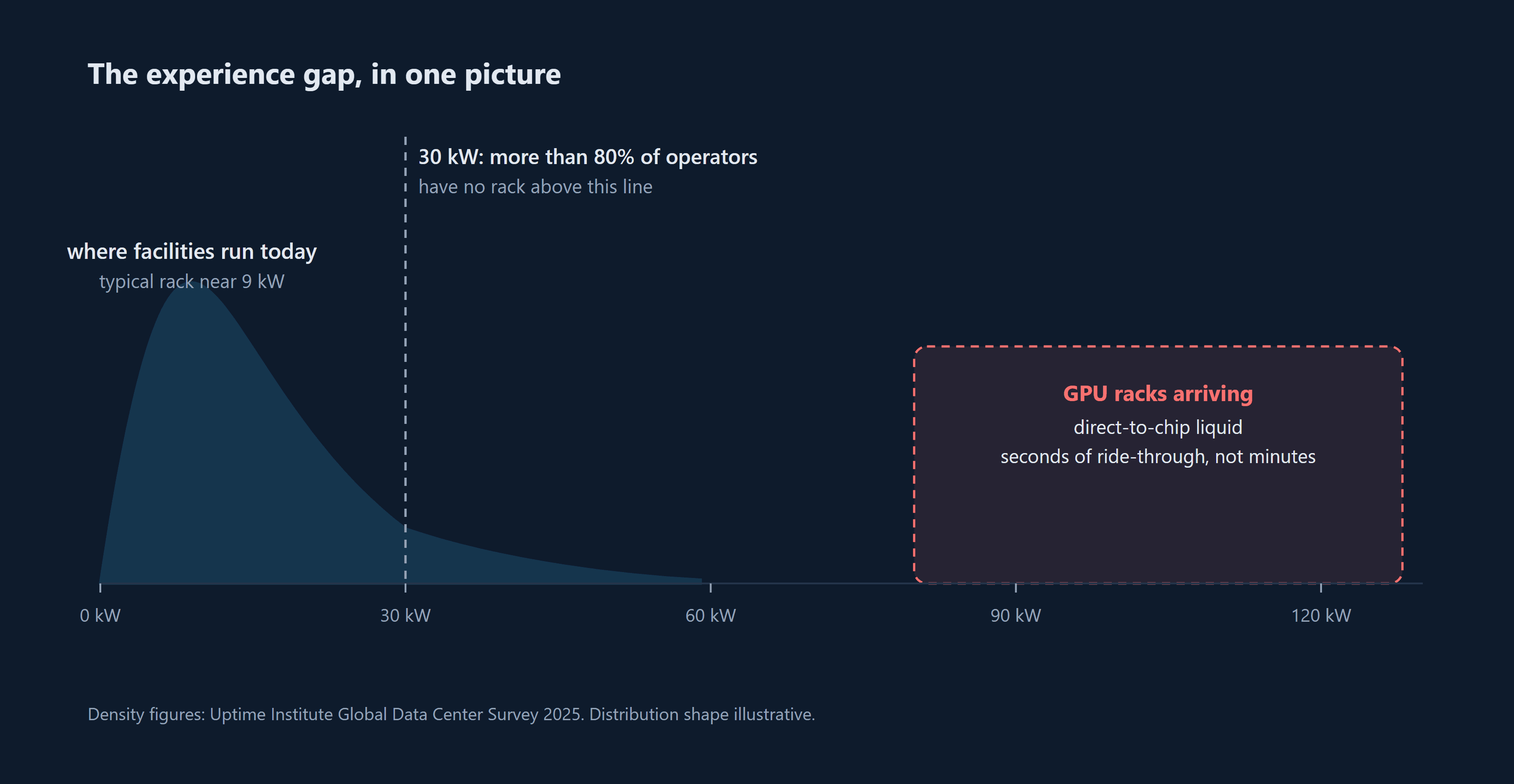
More than 80 percent of operators have never run a rack above 30 kW, and the typical facility rack sits near 9 kW. The GPU loads arriving now run far hotter, on pumped liquid, with seconds of thermal ride-through instead of minutes. The hardware will arrive on schedule. Here is the four week program that gets the team ready before it does.