
Monitoring Sites You'll Never Visit: A Field Guide to Distributed Infrastructure
Telecom huts, solar farms, substations, micro data centers, edge cabinets, modern infrastructure is spreading out, and most of it has no one on site. Monitoring an estate you'll rarely visit is a different discipline from running one big room. Here's a field guide to doing it well.
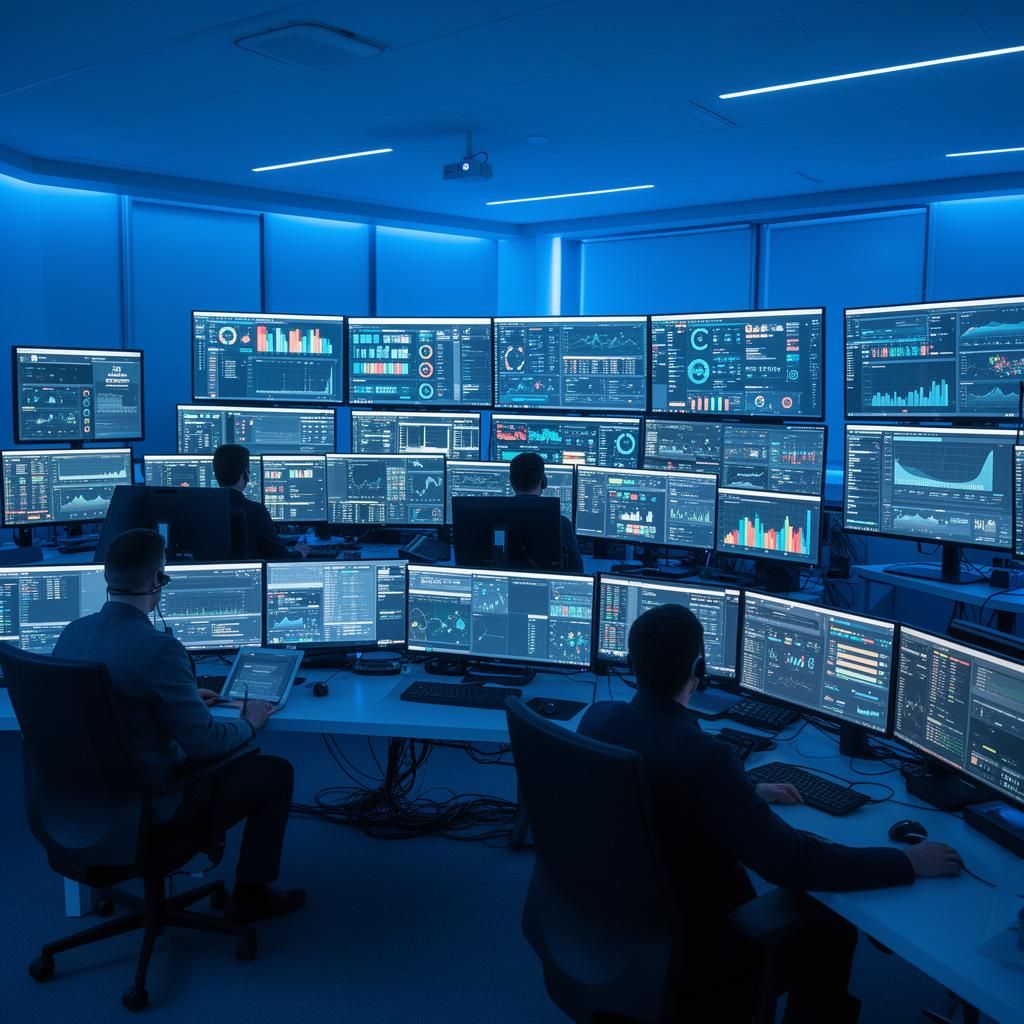
The data center used to be a place you could walk. Today, a growing share of critical infrastructure lives somewhere you won't: a telecom hut off a service road, a solar farm's inverter shed, a substation, a micro data center in a closet, an edge cabinet behind a retail store. The workloads are real and the uptime expectations are high, but nobody's there.
Monitoring an estate of sites you'll rarely visit is a different discipline from running one big room. This is a field guide to doing it well.
The estate problem
When facilities are distributed, three things get harder:
- Visibility fragments. Each site tends to grow its own tool, its own login, its own quirks. The "estate view" becomes a folder of bookmarks.
- Every truth check costs a drive. Without remote reach, confirming anything means a site visit.
- The link itself is fragile. Remote sites ride whatever connectivity they can get, and that connectivity is often the least reliable part of the system.
The goal is to make a site 500 km away as visible, and as actionable, as the one down the hall.
One pane of glass that's actually one
The first principle is consolidation. Every remote facility should roll up into a single estate-wide view: a live status tile per site, color-coded by health, filterable by region, drillable down to the individual rack, device, and port. Green when healthy, amber when something needs a look, red when it's real.
This isn't cosmetic. A unified model is what makes everything downstream, alerting, reporting, capacity, automation, possible. Forty tools can't be correlated; one model can.
Edge buffering: don't lose data to the outage
Remote links drop. The question is what happens to your data when they do. A well-designed edge node keeps collecting locally while the WAN is down and back-fills when the link returns, so an outage leaves a gap in connectivity, not a hole in your history. You want the post-incident timeline to be complete, that's how you find root cause.
If your monitoring "recovers" from an outage with a blank patch where the incident was, you're missing the most important data you'll ever collect.
Alerting that finds the on-call
At estate scale, alert routing matters as much as alert detection. A good system:
- Sends threshold and anomaly events to the right person in seconds.
- Attaches the context, the site, the reading, the runbook, so the responder isn't starting from zero.
- Escalates when no one acknowledges, instead of dropping the alert into a muted channel.
The measure of success is boring on purpose: the right human knows about the right problem before a customer does.
Power and environment are the quiet killers
For unstaffed sites, the failures that hurt most are rarely exotic. They're power and environment: a feed that drops to a single source, a cooling unit that quietly fails, a door left open, humidity creeping up, a battery string degrading. These are cheap to sense and expensive to miss. Instrument them first, temperature, humidity, power feeds A/B, door, leak, because they're the ones that turn into 2 a.m. emergencies.
Reaching in when it matters
Visibility tells you something's wrong. Out-of-band access lets you do something about it without a drive, especially when the primary link is the thing that failed. The combination is what makes "unstaffed" sustainable: see the fault remotely, triage it remotely, and reserve the truck roll for the times you genuinely need hands on hardware.
A practical rollout
You don't have to boil the ocean. A sequence that works:
- 1Deploy monitoring hardware at each site, starting with the ones that hurt most when they fail.
- 2Connect each site home over the most resilient link available, with edge buffering on.
- 3Aggregate everything into one estate view, kill the per-site logins.
- 4Route alerts to real on-call paths with context and escalation.
- 5Add reach, out-of-band access so you can act, not just observe.
Distributed infrastructure isn't going to re-centralize. The operators who win are the ones who make distance irrelevant: one view, complete history, alerts that find a human, and the ability to reach in from anywhere.
Running sites you can't easily get to? [See how remote monitoring would map to your estate](/request-demo/).
See it on your own racks
Book a walkthrough mapped to your environment: monitoring, asset management and out-of-band resilience across every site.
More insights
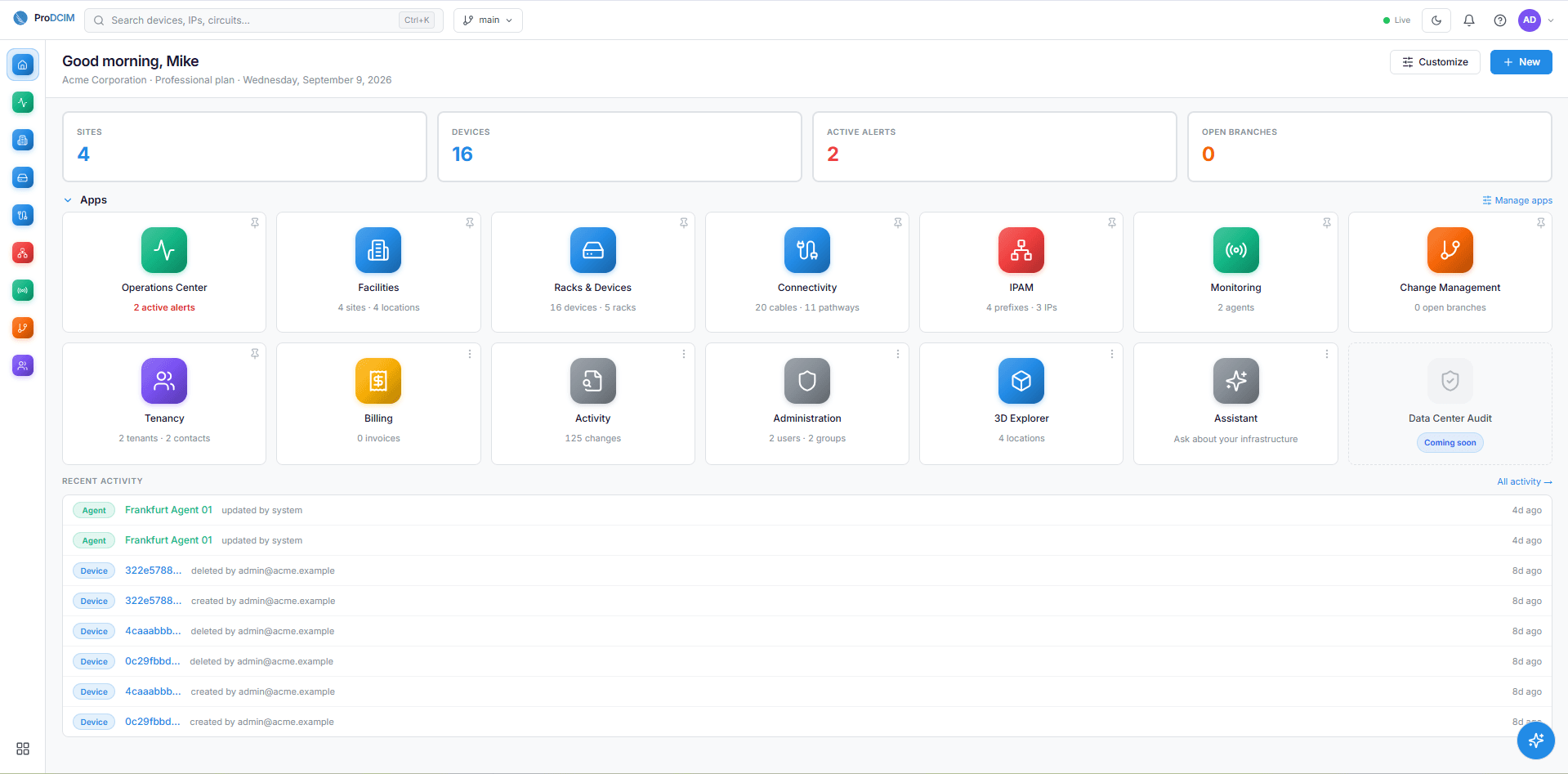
Why does it take so long to find the equipment behind an alert?
A PDU circuit crossing 80 percent names a circuit, not a device. When the floor plan, the asset register and the power readings live in separate systems, closing that gap is the slowest part of the shift. Here is what changes when they share one model of your infrastructure.
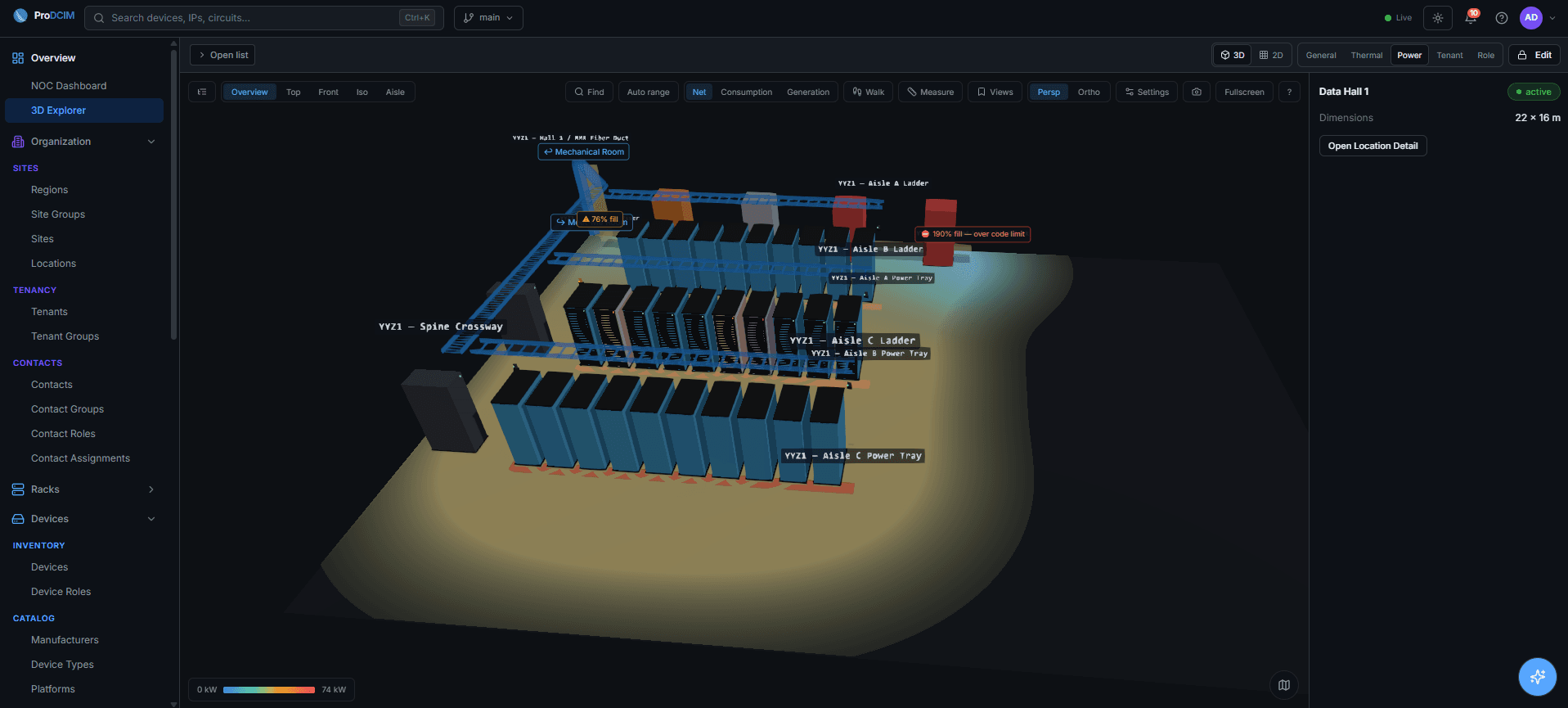
Racks Are Getting Denser. Confidence in the Data Is Not.
Uptime Institute's 2026 survey shows racks at 50 kW or more rose from 10 to 13 percent in a year, while racks under 10 kW fell from 32 to 25 percent. Over the same period operators reported the least confidence in the completeness of their operational data, which is the property that decides whether you can act on it.
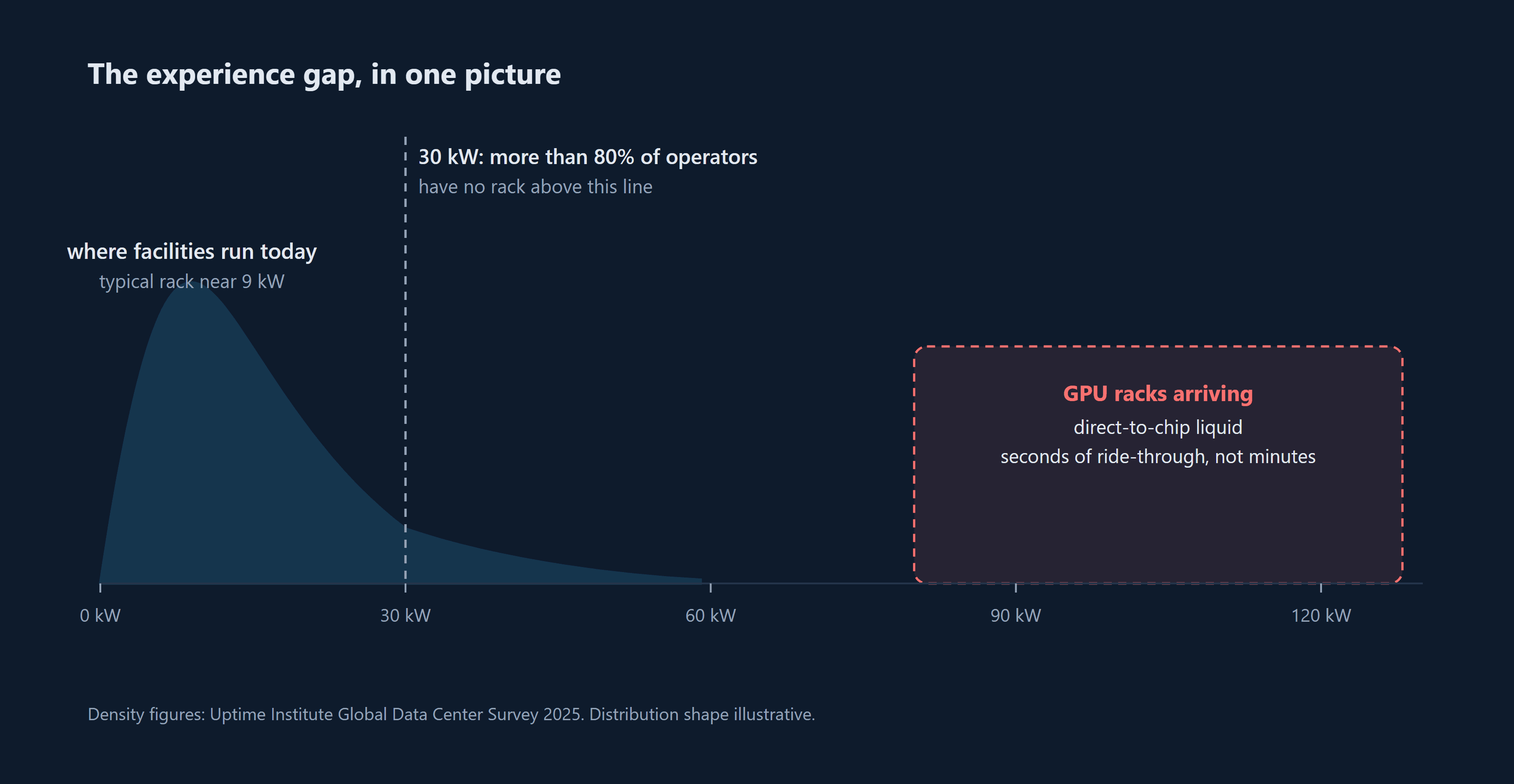
Liquid Cooling Is Arriving Faster Than the Skills to Run It
More than 80 percent of operators have never run a rack above 30 kW, and the typical facility rack sits near 9 kW. The GPU loads arriving now run far hotter, on pumped liquid, with seconds of thermal ride-through instead of minutes. The hardware will arrive on schedule. Here is the four week program that gets the team ready before it does.