
The Grid Can Now Tell You to Turn Down. Almost Nobody Can Prove They Did.
In 2026 curtailment stopped being a favor and became a condition of service: full-load shed inside thirty minutes in Texas, first-to-be-cut status in PJM, a Level 3 alert from NERC. Every one of those is a measurement and attribution problem before it is a power problem.
The instruction arrives in the middle of a hot Tuesday afternoon. Reduce by a defined number of megawatts, inside a defined window, and hold it. Nobody in the room disputes that the site can physically draw less. What stops the room is the next question: which megawatts. Which feeds carry them, which racks sit behind those feeds, which customers sit behind those racks, who is allowed to authorize turning them down, and what happens to the hall's inlet temperatures forty minutes later. The building has plenty of instrumentation. What it does not have is an answer.
That gap used to be tolerable, because flexibility was a commercial nicety you could negotiate slowly. This year it stopped being optional, and the industry is still discussing it as an energy-procurement story when it has already become an operations story.
Flexibility stopped being voluntary
Look at the 2026 record in order, because the direction is unmistakable.
On May 4, NERC issued a Level 3 alert, its highest tier, with seven essential actions aimed squarely at large computational loads and responses from grid entities due back by August 3. The trigger was not a shortage. It was behavior: customer-initiated load reductions and significant oscillations playing out over seconds, fast enough to matter to the bulk power system.
On June 30, amid a heat wave, the Department of Energy issued a pair of 202(c) emergency orders: one letting PJM run specified generators past their normal permit limits, the other letting it call on backup generation at data centers and curtail large loads that have it.
On July 23, the Texas PUC approved a 260 MW data center co-located with a wind farm, and priced the approval in obligations: the site must be capable of curtailing its full load within thirty minutes, by physical breaker disconnection if necessary, with ERCOT giving sixty minutes of notice only when practicable, and without demand-response compensation for doing it.
On July 27, the PJM Board directed two filings to FERC, including a large-load framework with a 50 MW threshold. New large loads that have not brought their own generation or otherwise secured supply by June 1, 2027, go to the front of the curtailment queue during shortages.
On August 3, the Texas governor paused new data center grid connections pending a comprehensive audit of a queue running to hundreds of gigawatts of interconnection requests, roughly ninety percent of it data centers.
Read together, these are not five news items. They are one message: continued access to the grid is becoming conditional on demonstrable, fast, verifiable load reduction. New York's statewide hyperscale moratorium and a summer of local opposition are the political weather behind it, but the part that lands on your shift is a performance requirement with a clock on it.
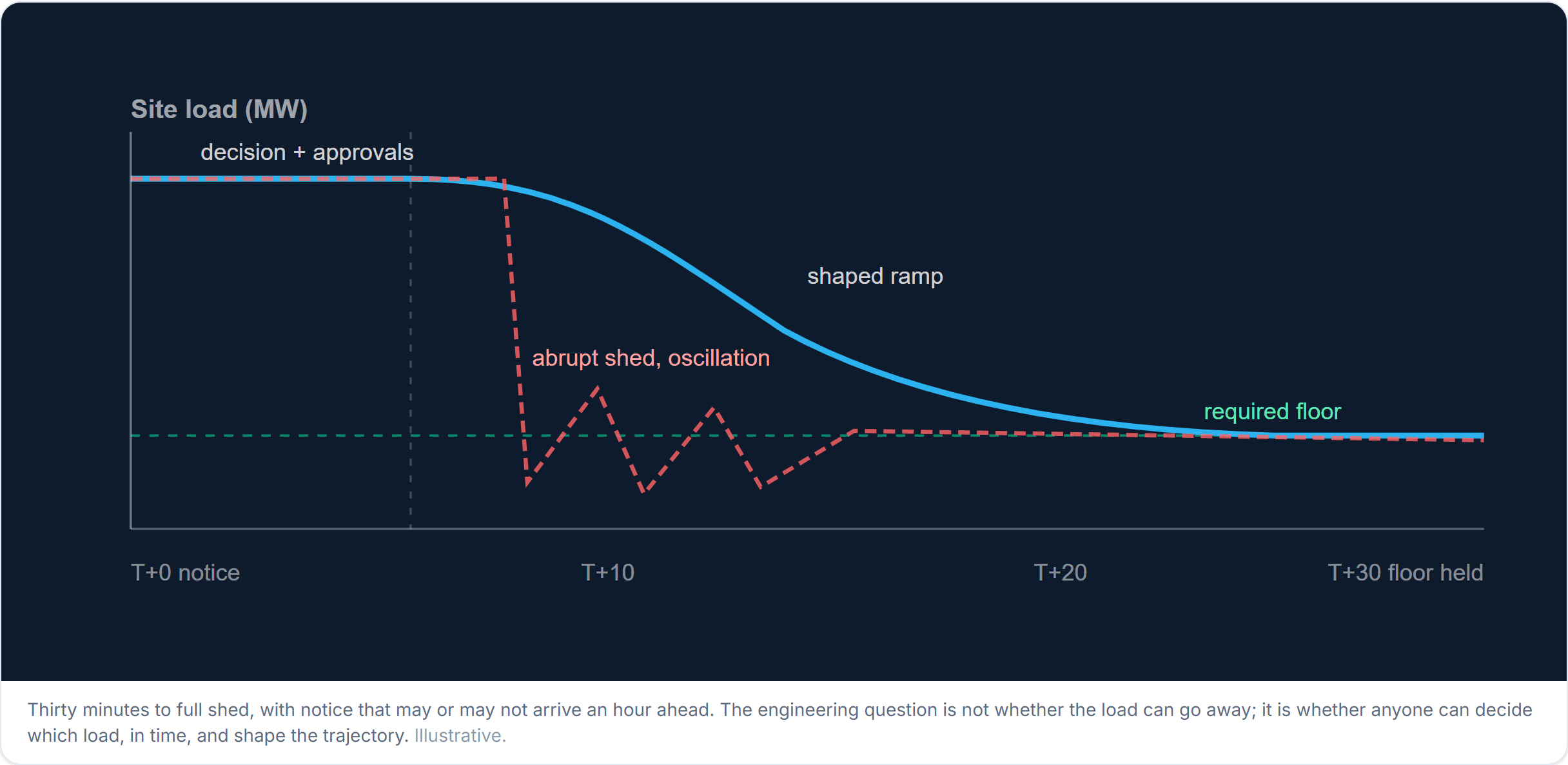
Thirty minutes to full shed, with notice that may or may not arrive an hour ahead. The engineering question is not whether the load can go away; it is whether anyone can decide which load, in time, and shape the trajectory. Illustrative.
A curtailment order is a query your estate cannot answer
The reason curtailment is hard is that the instruction arrives as a number, and the number has to be translated into circuits.
Most facilities meter beautifully at the two ends and poorly in the middle. There is a revenue meter at the service entrance that knows the total, and there are device-level readings that know a single power supply. In between sits the layer curtailment actually operates on: panel, feed, busway, rack, cabinet. If your model cannot roll consumption up from a rack to a feed and back down again, then a request for eight megawatts is not an operating instruction, it is a research project.
The attribution problem is worse than the metering problem. Shedding load in a multi-tenant hall means shedding somebody's service. That mapping, circuit to rack to service to tenant to the commitment you signed with them, is exactly the relationship data that spreadsheets cannot hold and that decays fastest in a hand-maintained inventory. A curtailment order interrogates it under time pressure, which is the worst possible moment to discover it is sixty percent accurate.
The load you can shed is not the load you have
There is a second-order effect that pure power accounting misses entirely, and it is where thermal and electrical models have to be the same model.
Dropping compute load does not simply subtract from the total. It changes the heat you are producing, which changes what the cooling plant should be doing, which is itself a substantial and largely non-sheddable electrical load. Ramp the wrong way and you come up short: you shed IT load, cooling keeps running at the old setpoint, and the reduction you delivered is smaller than the reduction you planned. Ramp back up and you get the inverse, a thermal debt that arrives after the grid event is over.
Then there is the shape of the ramp. NERC's alert was provoked by oscillations, not by magnitude. A site that dumps and restores hundreds of megawatts abruptly is a reliability problem even when it is nominally cooperating. Inline ride-through storage, static transfer switches and generator start sequences all shape that curve. Which means the deliverable is not a quantity of megawatts. It is a trajectory, and you cannot design a trajectory from data you do not record at the resolution the trajectory moves.
Shedding load is a permissions problem, not a breaker problem
This is the part that surprises operators the first time they rehearse it.
Every meaningful curtailment action crosses a boundary. It touches a customer's contracted availability, so someone in the commercial organization has an interest. It may trigger a service credit, so finance has one. It requires an authorized person to accept the consequence, and that person is frequently not the person holding the radio at the time. Under a thirty-minute clock, an approval chain that has never been written down is indistinguishable from having no approval at all.
Which is why curtailment belongs to the same family of work as a maintenance window, not to the family of emergency reflexes. It has a defined scope, a defined blast radius, a defined authorizer, and an expected end state. The organizations that will handle this well are the ones that pre-model the shed: an ordered list of what goes first, second and third, with the tenant impact and the required approval already attached to each tier, agreed in daylight and rehearsed. Improvisation is what produces the oscillations regulators are now writing rules about.
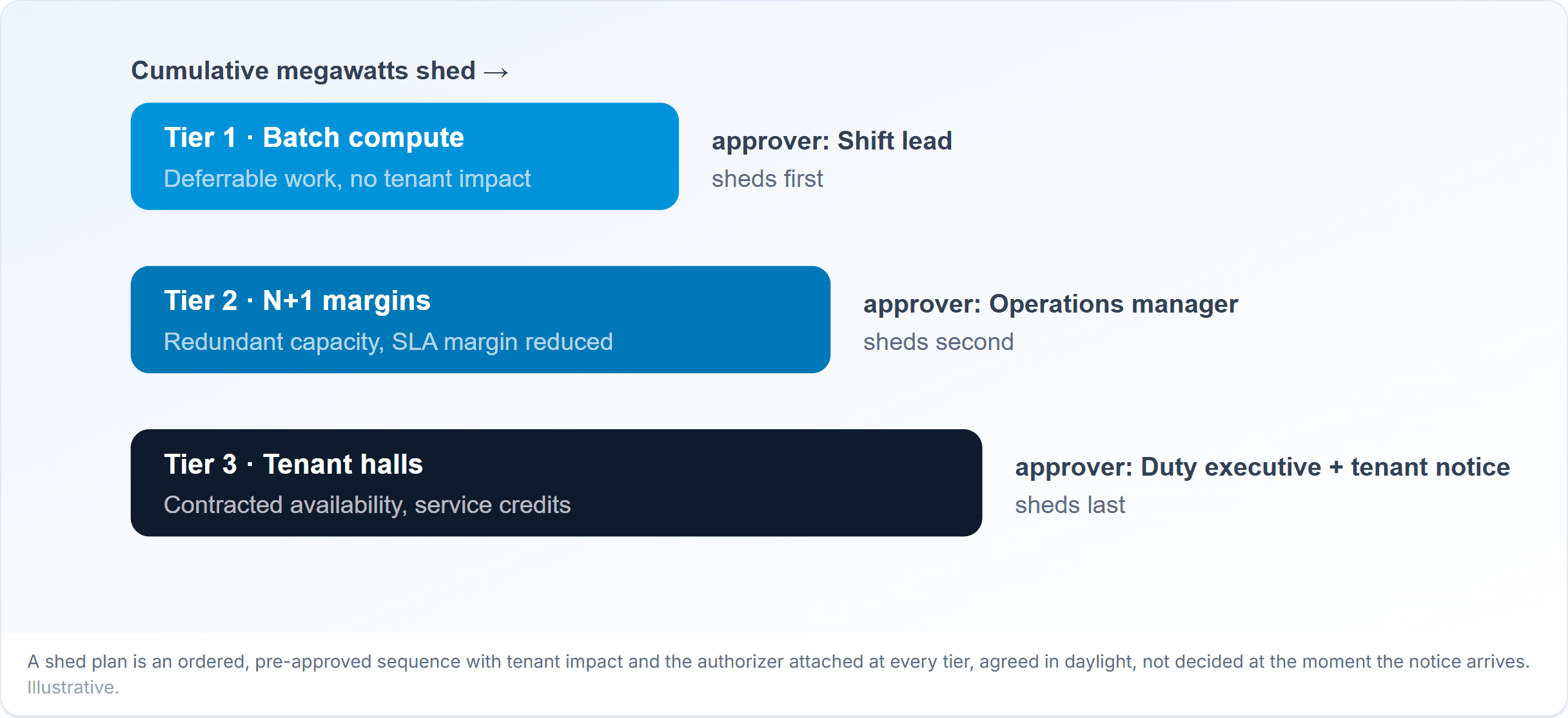
A shed plan is an ordered, pre-approved sequence with tenant impact and the authorizer attached at every tier, agreed in daylight, not decided at the moment the notice arrives. Illustrative.
Then you have to prove it
Here is the quiet sting in the Texas order. Curtailment without demand-response compensation means the return on complying is not revenue. It is continued permission to operate. And permission is granted on evidence.
Evidence means a defensible baseline, what you would have drawn absent the event, and a measured actual, time-aligned to the dispatch instruction, at a resolution fine enough to survive a challenge. It means knowing when the notice was received, when the ramp began, what the trajectory looked like, when the floor was reached, when normal operation resumed, and who authorized each step. It means being able to produce all of that months later, unaltered, for a regulator or a customer arguing about a credit.
This is the same argument we made about failure signatures: you cannot analyze data you threw away. Measurement and verification is that argument with a compliance deadline attached. A site that reduced load correctly but cannot evidence it has, for regulatory purposes, not reduced load.
What it takes to be curtailable
Three things, in order, and the order matters.
1. Meter to the granularity of the smallest thing you would ever shed. If the shed plan's finest tier is a rack row, then rack-row consumption has to be a first-class, continuously recorded measurement, not something reconstructed later from device polling. Sub-metering is the raw material for everything above it.
2. Model the chain from circuit to commitment. Feed, busway, rack, device, service, tenant, contracted terms and the authorizer for each tier, held as live relationships in one source of truth. This is what turns a megawatt figure into a named, approved action, and it is worthless if it is only accurate on the day it was built.
3. Record and rehearse. Keep continuous, time-aligned power and thermal history with an immutable event log covering notice, decision, approval, action and recovery. Then run the drill against real telemetry, in a maintenance window, before a grid operator runs it for you.
The takeaway
The industry conversation about curtailment is still mostly about whether it is fair. That argument will continue, and it will not change what happens the first afternoon a dispatch notice lands. Interconnection is becoming conditional, and the conditions are expressed in units of measurement, attribution and proof rather than in megawatts alone. A facility can be electrically capable of shedding half its load and still fail the requirement, simply because it cannot say whose load it is, cannot shape the ramp, and cannot evidence what it did.
Being curtailable is not a power engineering upgrade. It is an instrumentation and record-keeping discipline that happens to be enforced by a grid operator.
This is the shape of problem ProDCIM was built for: continuous, time-aligned power and environmental telemetry down to the feed and rack, one live model tying every circuit to the rack, service and tenant behind it, and maintenance windows, approval policies and an audit log so a shed plan can be defined, authorized and evidenced rather than improvised. If your interconnection is about to come with conditions attached, those conditions are answered with data you either kept or did not.
Sources
- NERC, NERC Issues Level 3 Alert, Reliability Guideline Focused on Large Load Challenges, May 4, 2026. nerc.com
- NERC, Level 3 Alert: Essential Actions on Computational Load Modeling, Studies, Instrumentation, Commissioning, Operations, Protection, and Control, May 4, 2026. nerc.com
- U.S. Department of Energy, Federal Power Act Section 202(c) emergency orders to PJM, Order Nos. 202-26-32 and 202-26-33, June 30, 2026. energy.gov
- Utility Dive, Texas approves AI data center co-location next to wind farm, with curtailment caveats (PUCT Docket 59220, order of July 23, 2026), July 2026. utilitydive.com
- PJM Inside Lines, PJM Board Directs Action on Resource Adequacy, Affordability and Large Loads, July 27, 2026. insidelines.pjm.com
- Office of the Texas Governor, Governor Abbott Directs Comprehensive Data Center Audit, August 3, 2026. gov.texas.gov
- Governor of New York, First Statewide Moratorium on New Hyperscale Data Centers Launched by Governor Kathy Hochul, July 14, 2026. governor.ny.gov
- Prochista, Your Equipment Told You It Was Failing. Nothing Was Listening for the Pattern., July 20, 2026.
See it on your own racks
Book a walkthrough mapped to your environment: monitoring, asset management and out-of-band resilience across every site.
More insights
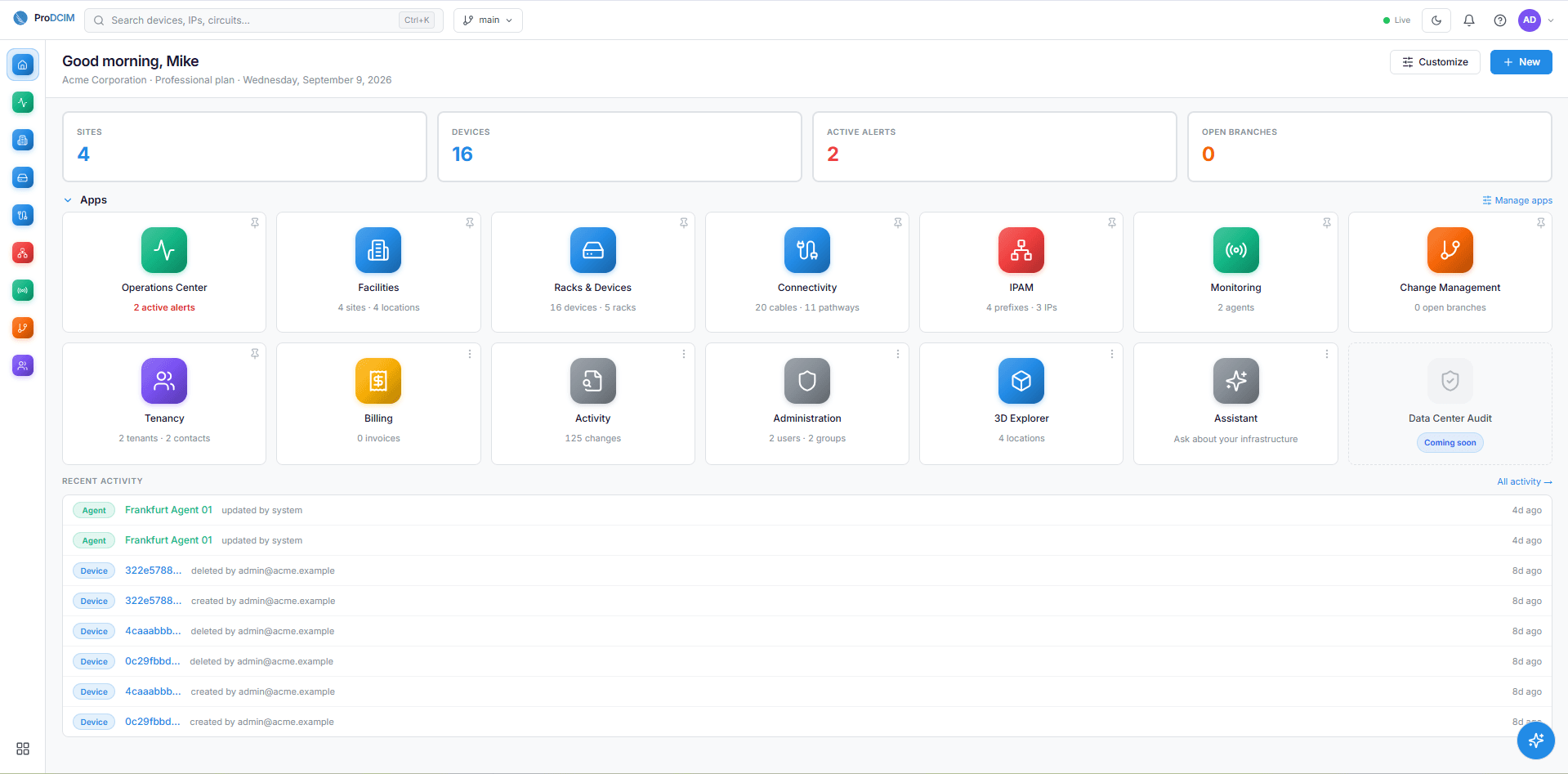
Why does it take so long to find the equipment behind an alert?
A PDU circuit crossing 80 percent names a circuit, not a device. When the floor plan, the asset register and the power readings live in separate systems, closing that gap is the slowest part of the shift. Here is what changes when they share one model of your infrastructure.
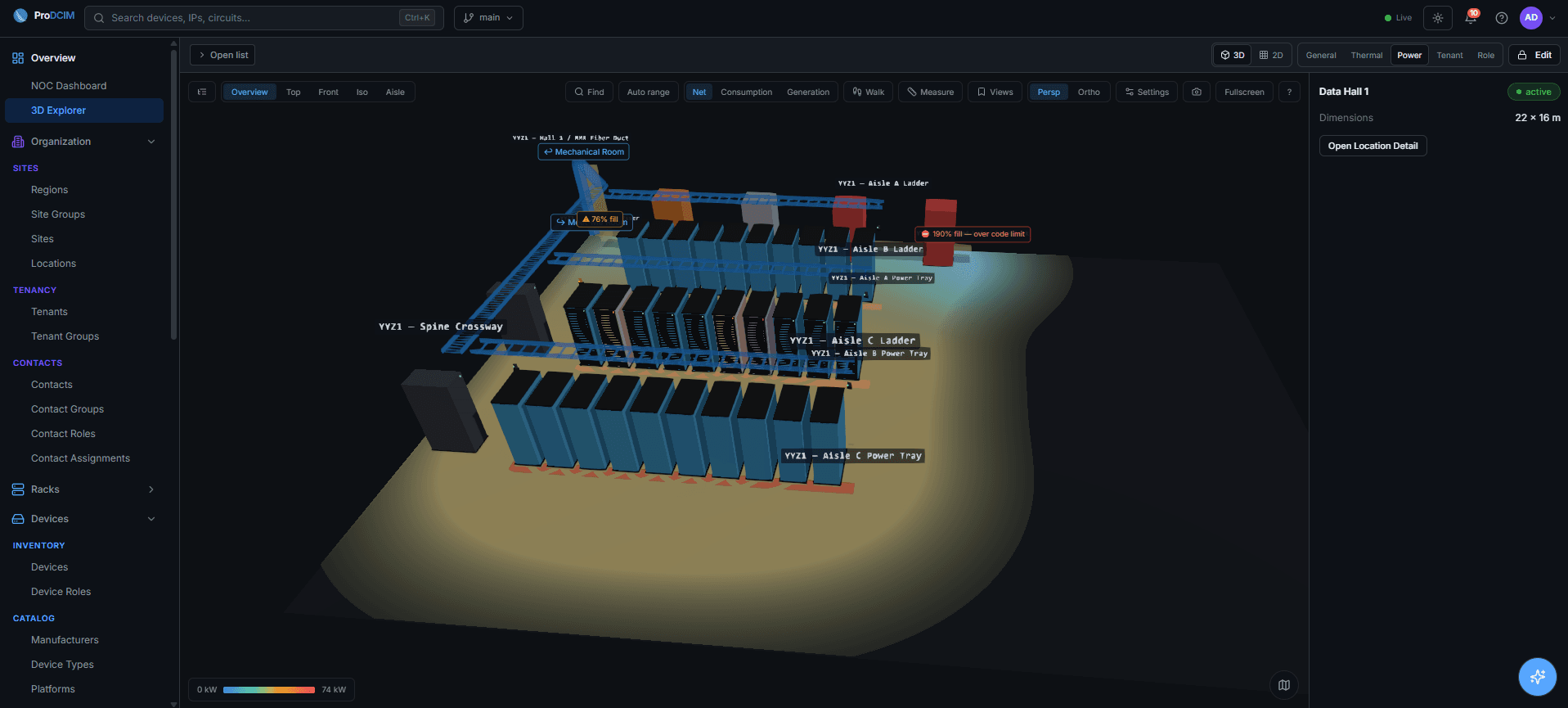
Racks Are Getting Denser. Confidence in the Data Is Not.
Uptime Institute's 2026 survey shows racks at 50 kW or more rose from 10 to 13 percent in a year, while racks under 10 kW fell from 32 to 25 percent. Over the same period operators reported the least confidence in the completeness of their operational data, which is the property that decides whether you can act on it.
Liquid Cooling Is Arriving Faster Than the Skills to Run It
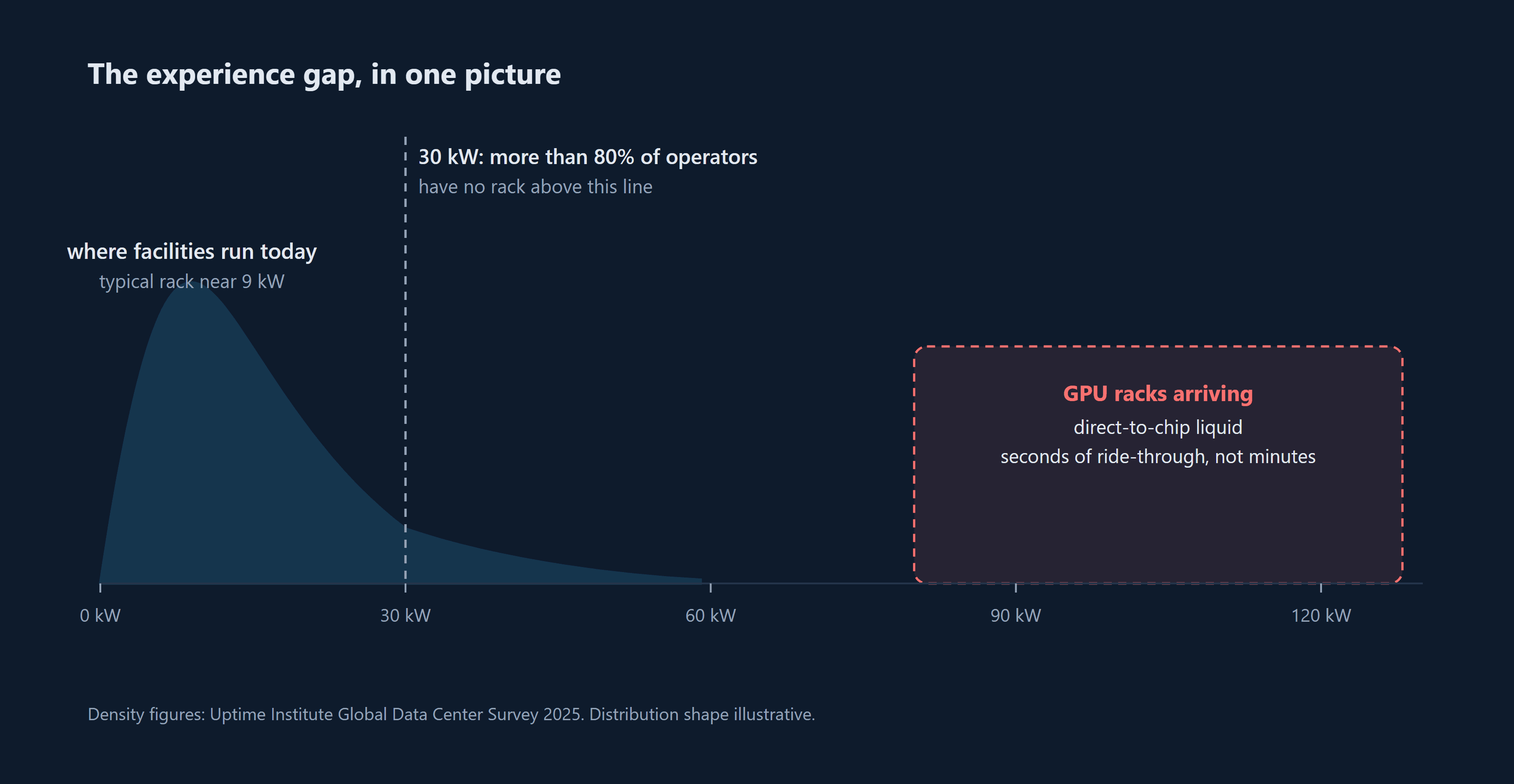
More than 80 percent of operators have never run a rack above 30 kW, and the typical facility rack sits near 9 kW. The GPU loads arriving now run far hotter, on pumped liquid, with seconds of thermal ride-through instead of minutes. The hardware will arrive on schedule. Here is the four week program that gets the team ready before it does.